
BOOB POLITICS
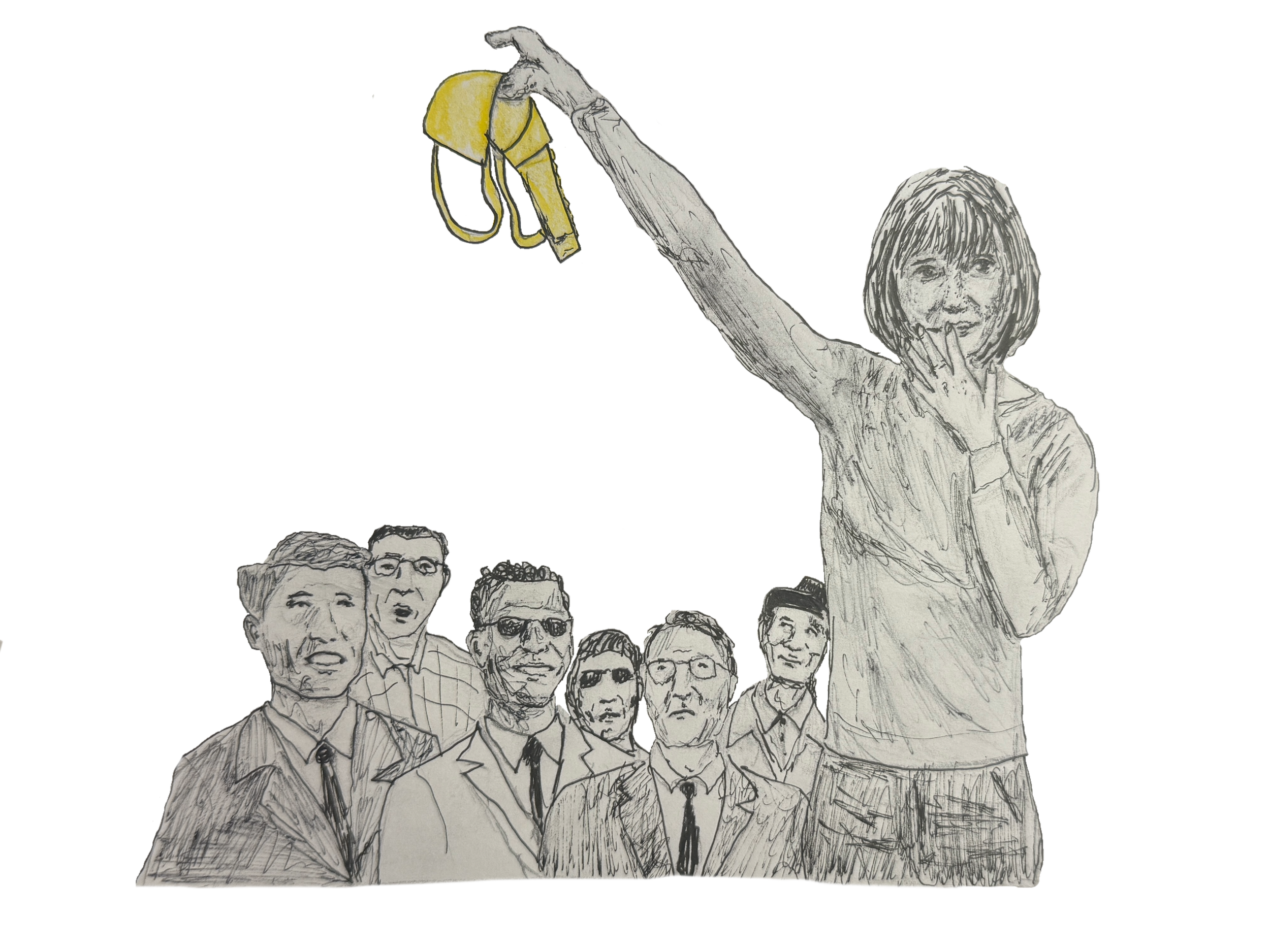
Art by Max Weinstein
Your tits don't have to start a revolution, but the correlation between sociopolitical ideology, breast trends and standards is undeniable.
Almost every social movement or era that includes women can be tied to a major beauty standard relating to breasts. Case in point: women chose to go braless during the era of second- wave feminism in the early 1960s and the sexual revolution of the 1980s.
Don’t get the two movements confused— they’re not the same. Women of the sexual revolution wanted to be seen sexually on their own terms. Second-wave feminism embraced sex- positivity by advocating for women’s pleasure and safety in sex, but criticized the sexual revolution for serving male desires and giving men greater access to women’s bodies.
The ‘80s saw the introduction of neoliberalism under the Reagan administration, and its core pillars persist today. Neoliberalism promotes solving sociocultural problems with market solutions, namely, private businesses and consumerism. To put this in the perspective of breasts, if you felt insecure about the appearance of your breasts, this ideology would tell you to consider augmentation since it’s a paid service from a private business.
The root problem at hand is unrealistic beauty standards. One's choices are to either spend money to fix the “problem” or live without conforming to the beauty standard. This whole conundrum reeks of choice feminism, which posits that if a woman makes a choice freely, that choice is feminist. Therefore, if a woman chooses to change her appearance through surgery, then plastic surgery is feminist.
The continual fight for gender rights is a double- edged sword. There are many accomplishments to be proud of, such as Title VII and Title IX, which outlawed workplace and education discrimination respectively. However, women’s bodies are unfortunately a pivotal part of political discourse in this country.
Unlike the past when women’s “delicate constitutions” needed to be sheltered, their bodies are now an open forum to all kinds of debate. The discussion is no longer just political, it’s cultural too. This heightened visibility cultivated harsher beauty standards. Once women’s sources of income and barriers to entry in male-dominated fields could no longer be controlled, people moved on to controlling their looks.
Moving right along on our great American boob tour, the ‘90s saw a sharp increase in saline implants after silicone implants were banned by the Food and Drug Administration in 1992. This happens to be the same year that Pamela Anderson and her two-year-old boob job joined the cast of the sexy beach drama, Baywatch. It’s important to note that during the ‘90s Anderson was a living beauty standard for women.
Another style that peaked during the same time period was heroin chic. Calvin Klein and his sultry, provocative work were criticized for promoting child pornography, using Kate Moss’ youthful figure as an art medium throughout the decade. Picture stripper tits on a pre-pubescent girl. That’s how unrealistic beauty standards are.
A similar juxtaposition was created in more recent times due to the growth of social media platforms. While big, fake boobs in tiny triangle bikinis are pushed out to anyone possible, regardless even of age, women’s nipples are conveniently never seen online. In the midst of this erasure, men’s nipples are broadcast in romcoms, photoshoots and runways regularly. Turning a part of many women’s anatomy into something forbidden only stands to hypersexualize breasts further.
Even with all this talk of progress, the crazy thing is that we’ve regressed as a society when it comes to boobs. Female breasts were very normal to see in mass media from the ’60s to ‘80s. From Sixteen Candles to Blue Lagoon, you couldn’t escape them. That being said, this era was problematic in its own way. While Blue Lagoon is a good example of nudity being normalized during this time period, Brooke Shields, the actress who went nude for the film, was 14 years old.
Breasts have been the battlegrounds for so many political causes over the years, it makes us at Jerk wonder if it’ll ever stop. But seeing how political ideologies have warped breast trends and standards over time is the first step to understanding that the policing of women’s bodies and the never-ending trend cycle that surrounds them has never really been about beauty. It’s about power and control.