
ARE WE FUR-REAL?
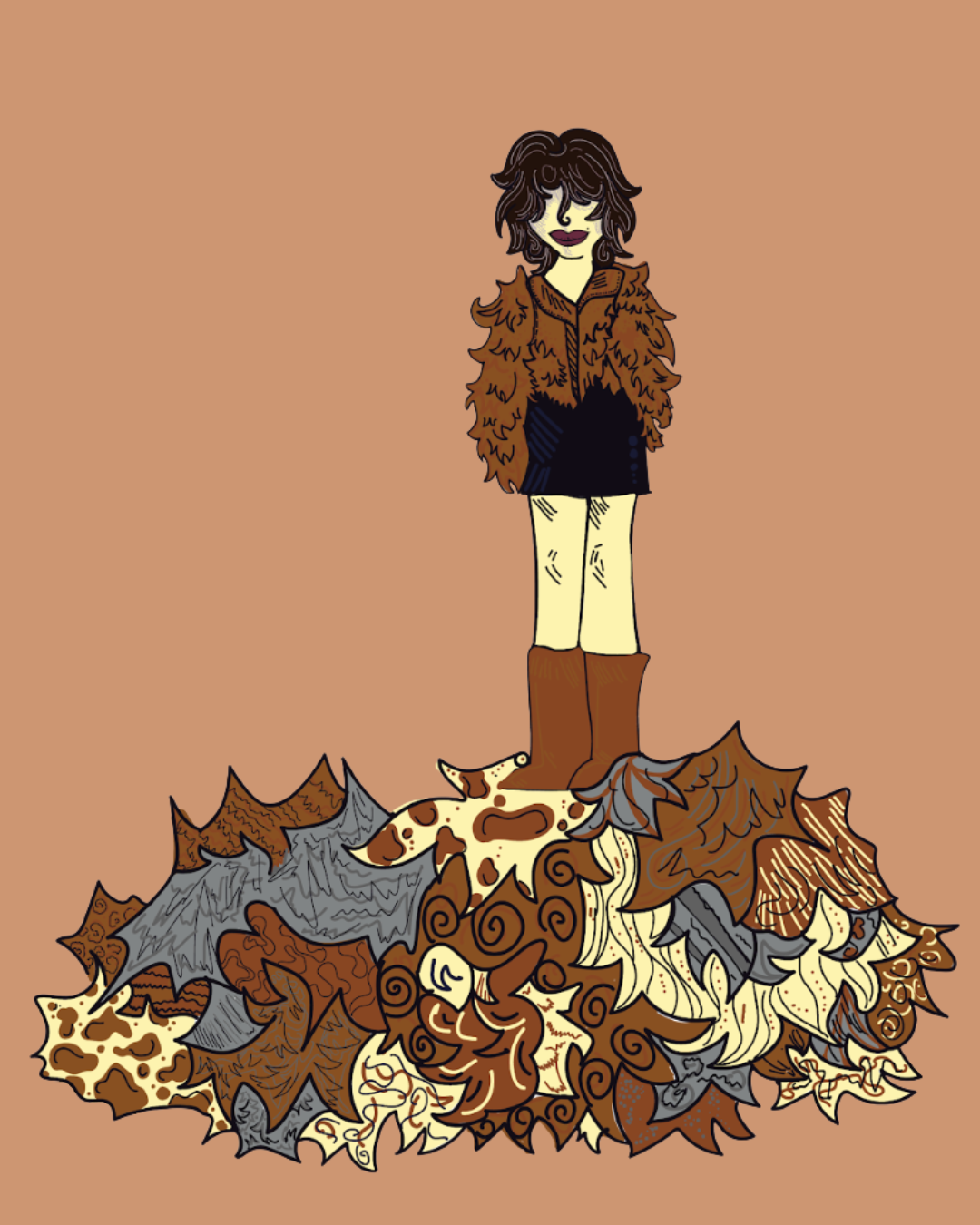
Art by Addison Pavone
As campus gets colder and seasonal depression rears its ugly head, students begin to pull out their warmest outerwear. It’s time to choose your fighter: the Are-You-From-New- York-Even black puffer jacket, the Whitman-bro Patagonia quarter-zip or that guy in your 8 a.m. who’s wearing shorts. Never fear, a new character has entered the arena—the fur coat.
Whether you want to look like mob wife Carmela Soprano or ’70s rockstar Stevie Nicks, fur is back. After a period of fur slander—protesters storming fashion weeks and model Gisele Bundchen labeled as “fur-scum”—consumers began opting for the plastic-based alternative. Faux fur products are marketed as responsible substitutions for stylish customers. Synthetic pelts have become a silent signal for fashionistas everywhere to say “I’m a good person—it’s fake!”
Fur has been a part of fashion since the beginning of humankind. Homosapiens crafted fur clothing to survive, skinning bison, mammoths and elk after hunting. Early North American indigenous societies, like the Inuit, were the first to assign a class association or rank to certain pelts, introducing the idea of fur as a style rather than a means of survival. The Northern Métis are considered the “children of the fur trade,” becoming skilled hunters and trappers to sell hides to European customers, establishing the early Canadian economy and bringing fur to a new continent, according to the Indigenous Peoples Atlas of Canada.
A lot of cultures have traditional dress with fur elements. Whether it’s a Peruvian alpaca-hair poncho or a sheepskin Kozhukh coat from Ukraine, fur is in our veins. But does that mean blood is on our hands?
In an era of Instagram activism and rainbow capitalism, it is easy to fall into the trap of the faux fur industry. These companies often practice greenwashing, the concept of making misleading claims about the environmental benefits of a product. Faux fur is vegan and its material appeals to the animal lovers of the world. People for the Ethical Treatment of Animals (PETA) has led the faux movement, condemning those who own pelts for their abusive, Earth-harming tendencies.
Faux fur isn’t as good for the environment as everyone says. Here’s something PETA would never tell you: faux fur is made of a combination of plastic polymers like polyester that shed microplastics at an unprecedented rate. Most faux fur coats are non-biodegradable, and with our culture of microtrends, these products are thrown in the landfill at record speed. Faux fur also has a shorter lifespan, around two to five years at best, while the real product can last for decades.
Similar to fur, genuine leather is making its own return. As “pleather” climbed the ranks as an affordable, eco-friendly alternative, real leather was donated and recycled to end up in thrift stores and resale sites worldwide.
Syracuse University sophomore Sheza Qasim stumbled upon a real leather piece without even knowing it, she said. After a Depop search for the perfect going-out jacket (been there!), she bought one. Only after checking the tag did she realize she purchased genuine leather.
“I had no idea that my jacket was 100% leather,” Qasim said. “I’ve seen the backlash against fur, and agreed with it on the surface. When I made that discovery, I did my research and it changed my mind about fur.”
In Syracuse, it is in every student’s best interest to own long-lasting outerwear. Even celebrities like Ice Spice and Kendall Jenner have been spotted wearing fur to high-profile events and red carpets galore.
In March, fashion house Fendi celebrated a century in business with a Milan runway—their message about fur was clear. Silvia Fendi, the only member of the Fendi family still involved in the company, stated that she wanted to honor Fendi’s origins through the show. With humble beginnings as a handbag and pelt factory, Fendi flaunted fur on almost every model. Silvia Fendi's twin grandchildren and eventual heirs of the empire sported miniscule matching fox coats.
In a world where a McChicken is $3.29, it is easy to feel disillusioned by fashion giants that peddle expensive pelts. But the easiest and most common way to get the real deal? Gen Z’s favorite pastime: thrifting! Most people she knows with fur or leather have thrifted it, Qasim said.
SU sophomore Emma Liao picked her fur coat up at Marshall Street’s 3fifteen thrift store. Unknowingly, she bought a piece that will last her much longer than the pieces she’s owned in the past.
“Honestly, I just picked out the coat that felt the best,” Liao said. “Quality is important to me and there was not a huge price difference between my purchase and lower quality options.”
Both Liao and Qasim acknowledge their experience with authentic fur was accidental, but now impact the way they will shop moving forward.
“I don't even think I've ever seen hate on faux fur, because people assume that it's not hurting an animal,” Liao said. “They think that it's perfectly fine. No one is thinking about the broader environmental impact.”
At the end of the day, in a society where we want things fast, cheap and easy, faux fur is the obvious choice. As consumers come to their senses, we’ve started to pull out our pelts and shop secondhand.
Next time you shop, think about this: am I buying faux fur because I love animals, or is this company telling me that I’m a better person for doing so? And, could I just get this at the thrift instead?
So, don’t be afraid to do your research and buy the coat that’s best for you. Or don’t. Just make sure you don’t get frostbite.