
MORE THAN JUST SOME FUN AND GAMES
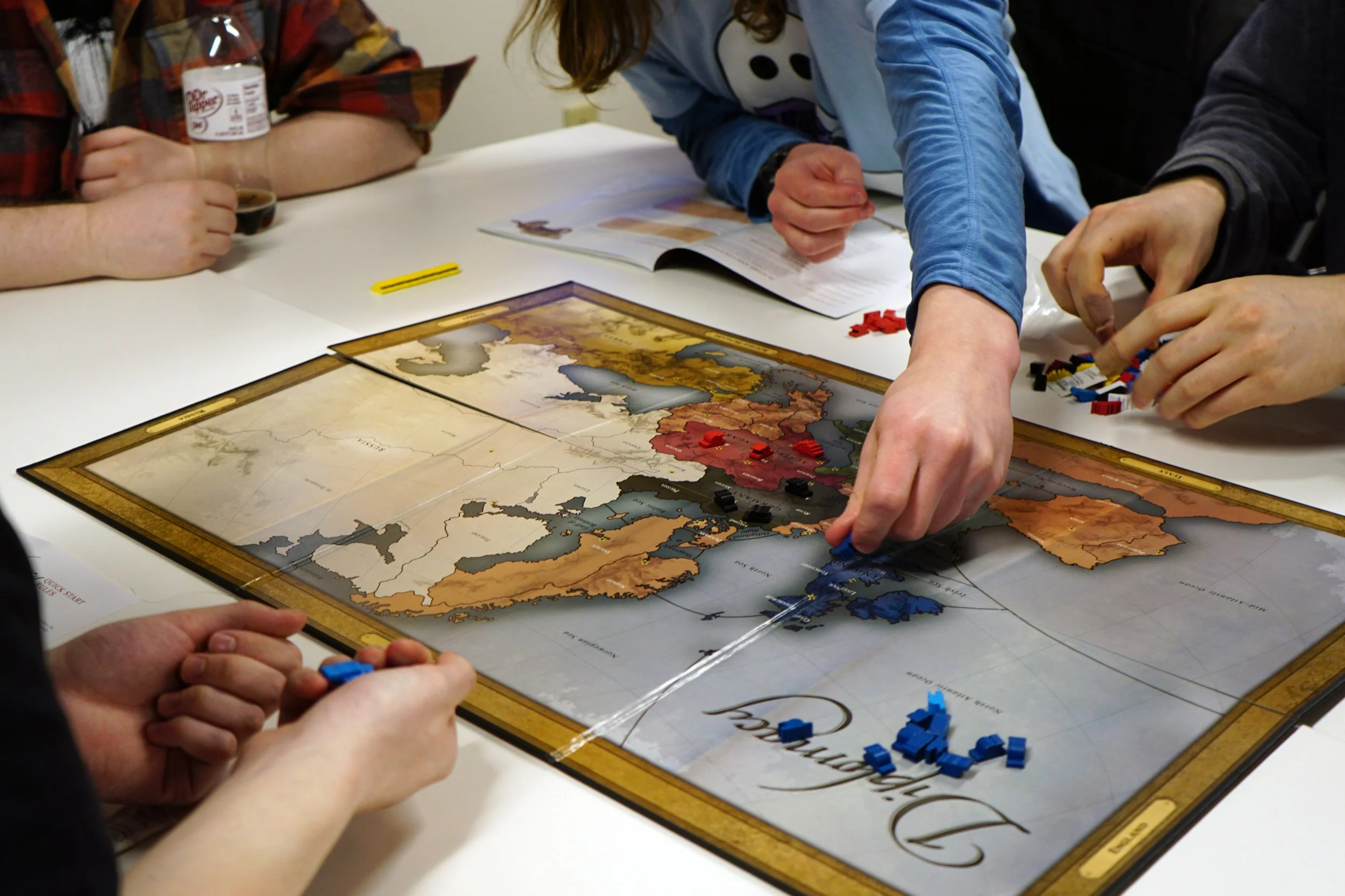
Image taken by Ailani Wong
Every Friday, the lights in the basement of Hinds Hall glow late into the night. Huddled around tables occupying several rooms is Syracuse University’s Gaming Club.
The club boasts 582 members on Discord, welcoming staff, faculty and alumni, with 60 registered on ‘Cuse Activities. About 30 to 50 members show up weekly to unplug after a long school week.
Jiaying Wang originally discovered the club after attending SU’s annual Involvement Fair with their friends and just kept showing up to meetings. From there, they applied for the club’s executive board, and were asked by the then-president to be vice president. Now a senior, Wang serves as the club’s president.
“I know [the club] has been around for a really long time, I think this outdates most other clubs on campus,” Wang said. “I think at first it was just kind of a small gathering of friends who like to play board games, but now it's kind of gotten a little bigger and gotten to be a more proper thing.”
Unlike most other clubs, Gaming Club’s meetings are simply a social gathering—there is no structure and members can come and go when they want. Starting at 7 p.m. every Friday, members slowly trickle into rooms and by 8:30 p.m. most tables are filled, with spare chairs brought in from the surrounding computer labs.
Meetings are supposed to end at midnight, but members often stay until 1 or 2 a.m. to finish the games they started hours prior. Members can choose from any of the estimated 100 games kept in the club’s designated cabinet and play for as long as they want.
Tables stay filled with varying numbers of people, from small groups to large groups and even as little as pairs. Members bring snacks and candy to share, and explain on the spot how to play different games.
But, the club isn’t just about the fun. It’s also a necessary outlet for stress relief.
“We have a couple members with really intense majors that need a lot of focus time during the week. We have a lot of architecture, a lot of biology, hardcore multiple-hour work weeks. So I think this is a really good way to just kind of let go,” Wang said. “So we see some members just on their laptops doing their homework. We see people not touch a board game at all and just talk the whole time.”
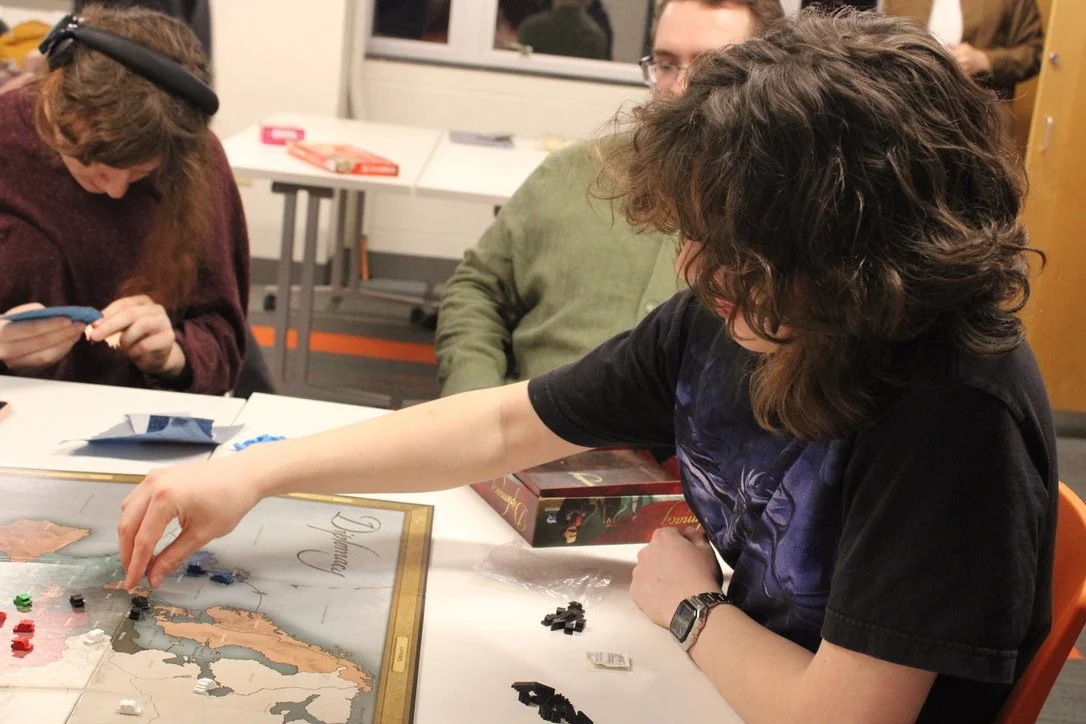
Image taken by Brynne Hurt
With that said, we at Jerk know the club has developed a reputation for being somewhat underground and mysterious. The club’s Instagram page isn’t active, so they rely on the Involvement Fair and word of mouth to maintain its dedicated membership.
“Every week, it's more or less the same people and you start learning their names and you start recognizing their faces,” Wang said. “Most of them do say they're from the Involvement Fair, but the first week of school we got a couple of surprise ‘Cuse Activities page scrollers that we almost never get.”
And, funnily enough, the Instagram inactivity is unintentional. The club doesn’t have a social media coordinator, but no matter, because word of mouth has been just as effective.
Sophomore Kenae Taylor (They/He) is Gaming Club’s events head and initially found out about the club from a friend. They enjoyed it so much that they just kept going, calling it the “ultimate point” of their week.
Because of the club, Taylor was able to make new friends, including their current roommate.
“It's one of the most positive things in my life, and this is the thing I do every week. I go, ‘Guys, I can’t, I have Gaming Club,’ and everybody's like, ‘We understand. Go, have fun,’” Taylor said.
From being on e-board, meeting new people and introducing others to the club, Taylor said the environment is what keeps them coming back every week. While other clubs require more concrete commitment, Gaming Club remains about the people who show up, regardless of how often they come.
“If you come once and then don't come again for a year, somebody will go, ‘Hey, how have you been?’ So, it's just really nice,” Taylor said.
Senior Kai Blunt joined his freshman year, but decided to dedicate himself to going every week his junior year after transitioning from housing in a Living Learning Community to living on South Campus. The friendships he formed through Gaming Club are ones he was still able to maintain during and after his semester abroad.
Even while in London, the impact of Gaming Club followed Blunt, taking him across the city to play a board game at the university where he studied.
The Gaming Club welcomes both undergraduate and graduate students and has members from all over, some of whom are international students curious about the American versions of their hometown favorites.
“Even if English is not their first language, they're still playing,” Blunt said. “I ran a game of “Werewolf” in Chinese with some people.”
Werewolf is a “social deduction” game, meaning that each player has to uncover the other players’ agendas and allegiances using a combination of logic, process of elimination and inquisition. These kinds of games often run late into the night, and are also the best ways to learn names and get to know new people.
One of Taylor’s favorite memories from the club is playing Blood on the Clocktower, another social deduction game.
“As we've been playing it a lot more now, people have stopped trusting me in a fun way of like, ‘I go in the games and then I'm evil, [and] ‘You were my friend, you betrayed me,’” Taylor said. “It's really fun to go out there and play the game to the best of your ability and lose or win in a big way.”
Another key trait to the club is its sense of acceptance. The games it facilitates break down the barrier of having conversations and asking questions that may seem intimidating or scary at first.
“We've had multiple people that come out, and people are immediately, like, on it with new pronouns and new names—this group is just always really good for that,” Blunt said.
Gaming Club also hosts game nights with other organizations on campus. Every fall, they host a game night in collaboration with Pride Union. They’ve also been able to collaborate with the e-sports department. Currently, Taylor is working on coordinating an event with the Society of Physics Students.
“There’s always such a good turnout because the club has such a strong member following,” Brenna McNamara, Pride Union’s social media manager, said. “The org is extremely easy to connect with and they bring a really nice, relaxing vibe to the space.”
What may seem like a ragtag group of students is really more of a family—one that adopts more and more people as time goes on.
“We just pull random people in who have no idea what this is. And they were like, ‘Well, I'm new to the place, and I need to meet new friends,” Blunt said. “Come play a board game. Be brave.”