
REGRETTING COLLEEN HOOVER (Copy)
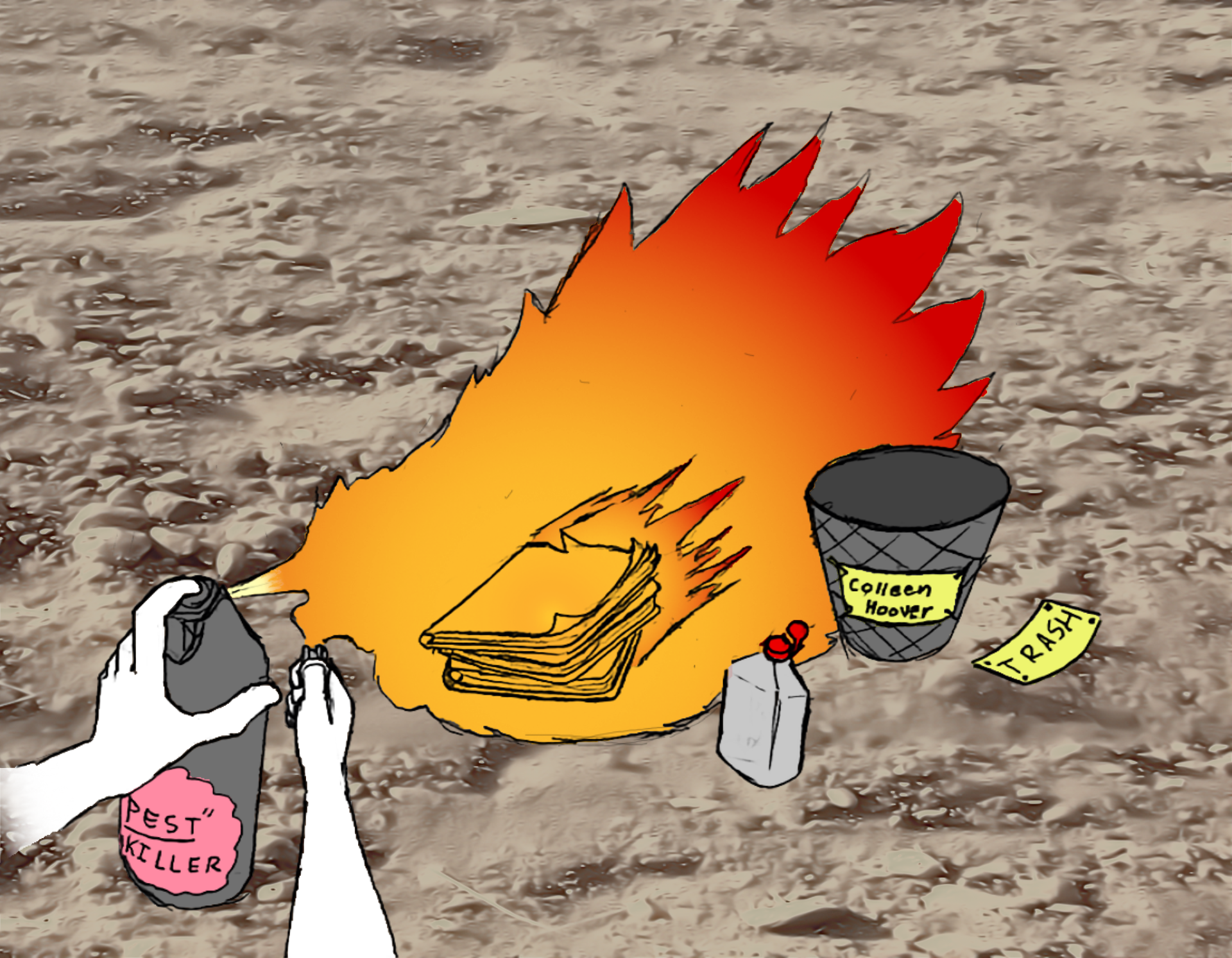
Art by Karl Lamb Jr.
Let’s set the scene. After a long day, you’re curled up on the couch, ready to unwind with a good book. You turn the page of a Colleen Hoover book, when all of a sudden your eyes are assaulted by a line such as:
“We both laugh at our son’s big balls.” “When he was wiping that cow shit on me, it was quite possibly the most turned-on I have ever been.”
“When he was wiping that cow shit on me, it was quite possibly the most turned-on I have ever been.”
And who could forget Hoover’s infamous line claiming sushi and pad thai are the “same thing” because they’re “both Asian food”?
The plague that is Hoover’s writing gained popularity on BookTok, a subcommunity on TikTok. This growing side of the app gave Hoover’s books a major surge in popularity, although many were written years before.
Hoover’s virality is, frankly, inexcusable. Who told this middle-aged white woman she could write? And how did she convince so many other people? This entire article could just be cringeworthy quotes of hers, but we respect our readers too much for that.
The bad prose is just the beginning. This woman’s list of controversies rivals that of a corrupt politician, complete with allegations of covering up sexual harassment. Let’s get serious for a minute.
In 2022, Hoover’s then-21-year-old son was accused of soliciting a 16-year-old girl for inappropriate images. When the girl reached out to Hoover, she reportedly blocked the message— until the internet found out about the ordeal. Then, she gave a half-assed apology on Facebook and claimed she never saw it.
Keep in mind, the content of some of her novels includes triggering topics like assault and domestic violence. The fact that she uses these subjects to sell crappy books without practicing prevention of such events is a testament to her character. And it’s not a good one.
We’re sick of reading about stale white bread characters over and over again, especially when they’re some of the only books being pushed by BookTok and Bookstagram. Take our word for it—these are not the places to go when you’re looking for a good book. The closest thing to P.O.C representation we’ve seen in any content of hers was the casting of Hasan Minhaj in the shitshow that was It Ends With Us, where he played a tech entrepreneur. Interesting casting for a brown man, no? That’s what you get when you bolster an author that’s just as stale and white as her characters.
Hoover’s writing itself also says a lot about her: having a character refer to all Asian food as “the same thing,” having another say he can pick how a girl dresses because he’s paying for dinner, and having yet another talk about someone “experimenting” with being gay. It’s safe to say that Hoover’s got a lot to make up for—and there are only so many mistakes we can allow.
Here lies Colleen Hoover. Let’s keep it that way.