
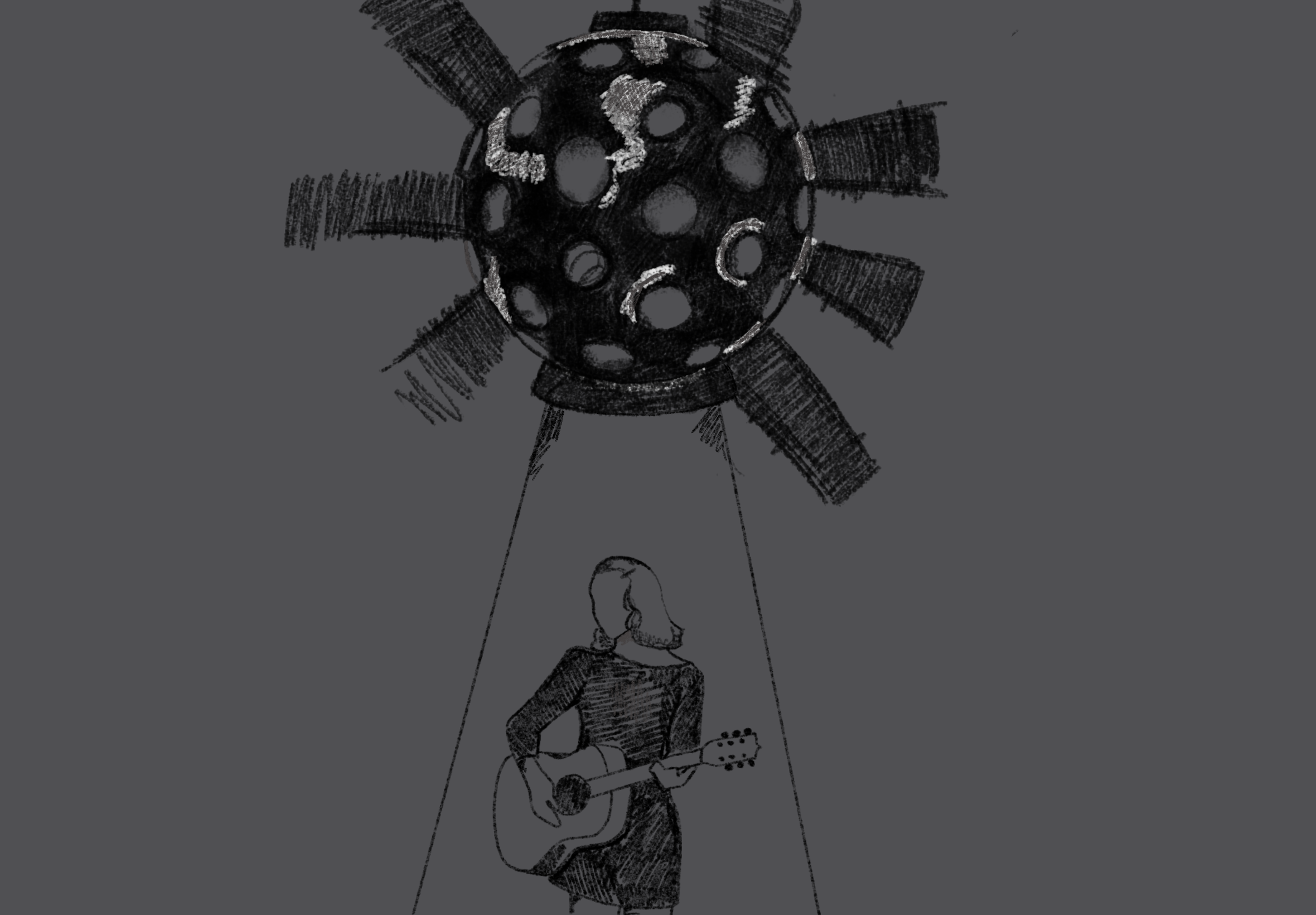
Graphic by Annie Smith
In the modern resurgence of music appreciation, concerts have become a space of both music and experience. Getting ready, taking pictures both beforehand and at the venue, filming videos to show coworkers and then finally curating that perfect post. It is impossible to take a video at a concert without catching hundreds of phone screens in the foreground. This has become the expectation.
Phoebe Bridgers says no to this new normality. Starting in May, she began a series of pop-up events throughout the country. These small concerts were hosted in towns outside of metropolitan areas, with some fans creating rumors that the locations were meant to be in places with known UFO or alien sightings. Yet, according to a Pollstar interview with her agent Dave Rowan, Bridgers intended to ensure that fans would have access to performances. Venue capacities ranged from 150 to 600 people and fans were given Yondr pouches to lock away personal devices for the duration of the show. This experiment inevitably produced satisfying results for both Bridgers and fans, leading to the announcement of an international album tour that would be strictly device-free.
This decision received a flurry of online recognition and criticism. Many praised the initiative for its attempt to combat the near-constant use of phones during concerts. Ky Farrell, a sophomore at SU, was initially concerned about the logistics of completely removing phones from the performance. But after attending an album launch party, their worries were quickly overruled by the joy of a phone-free experience.
“I was always worried about my phone storage for videos that I would watch maybe once. It sounds ridiculous, but I also used to worry about my seats within the venue and whether they would be suitable for my pictures,” said Farrell. “With this concert, I was less worried about having a good seat. The lack of recording made it feel so much more personal, and I actually watch and sing now! It is the way I want to experience every concert.”
Simultaneously, there have been concerns for fan safety, online claims of ableism towards fans with medical issues that warrant phone assistance and an overall pushback toward the idea of an artist directly controlling what fans do while in a concert space. SU senior, Dora Gordon, acknowledges possible downsides to phone limits, but overall thinks highly of her experience.
“I thought the phone ban was fine. I saw a girl walking and trying to talk on the phone through her Yondr pouch, which must suck if you are trying to find your friends in the venue,” said Gordon. “If you don’t have assigned seats or a designated meeting spot, like bye. Safety concerns should obviously be taken to heart, but I felt incredibly safe with this concert. Literally the most magical show.”
On Friday, Sept 18, I skipped Chancellor Mike Haynie’s Inauguration to fly to Chicago. I had two pit tickets to―what many could describe as―the most gut-wrenching tour of the year. Upon arrival at the United Center, it was the typical horde of young adults taking pictures outside of the venue, during which I was brutally fitmogged. But, for this concert, there was a new weight to these pictures. This is some of the only proof that people would have.
As always, the lines to enter the concert were incredibly long. This was amplified by the added step of people placing their personal devices into locked Yondr pouches. There were numerous attendees who were not informed of the device ban, so they held up the lines by arguing with the venue staff. Once in the arena, there were even more lines. Merchandise queues snaked through the concourse, halting further for people who forgot to bring a physical card. My consistent reflex to scroll on my phone while waiting in line was never more apparent, and―while this is ultimately unimportant―it was incredibly inconvenient to not know the time.
This concert was insane. I was completely surprised by every aspect because there is a lack of physical evidence to provide spoilers. The most magical part of it all was looking into the arena seating from the pit and only seeing a sea of faces, not phones. People were free to cry violently into their best friend’s arms during “Waiting Room” and skip in circles during “Haunted.” There was no fear of being posted on social media, just being seen by someone who will probably never be around again. The warm glow of a lighter flame replaced the sterile light of a phone flashlight. I felt immensely connected to the community around me and the art itself. Bridgers herself halted the concert for a moment to thank everyone for their cooperation and share just how much it meant to her.
“I really want to thank you all for giving up your phones tonight. I know it's hard, but it really is that deep. It makes it feel way more intimate for me, and I hope it feels the same way for you,” said Bridgers.
In my outlook, it is on brand for her to implement device restrictions, and it actually adds more emotional connection to her art. Following the death of her father in 2023, Bridgers experienced an influx of digital attention that didn’t even surround her grief, but a new relationship with comedian Bo Burnham. Banning phones and social media coverage makes sense for a concert surrounding grief and complex sadness. This restriction is especially fitting because Bridgers was shoved into the public eye during the very experience that inspired her music.
Morgan Magats, an SU junior studying Communications and Rhetorical Studies, has seen Bridgers in concert four times. But her experience on Friday, Sept 25. carried a particular emotional weight.
“Phoebe mentioned that she took a three-year hiatus because her dad passed away, and her music was getting a lot more attention at that time. She knew she wanted to get phones out of her face when she went back to touring. Inherently, a lot of people love her music because of the comfort it brings in times of solace and sorrow. If I experienced what her songs are written about, I would never put that out there,” said Magats. “It’s such a personal thing that having that plastered all over the internet would be really invasive. The only way she could do a tour like this, with her own sanity, is without phones.”
Banning phones across every concert is close to impossible. Not every artist has the resources and funding to enforce such a ban like Bridgers has been able to. However, the culture of concert-going can be shifted to be a more phone-free experience. Instead of taking endless videos that may be viewed once, we can instead capture the moment internally and focus on the music—and performance—that we paid to see.
Live in your Phoebe Bridgers-induced misery without worrying about camera clarity. I promise you that no one is watching the ten minutes of concert footage that you put on your Instagram story.