
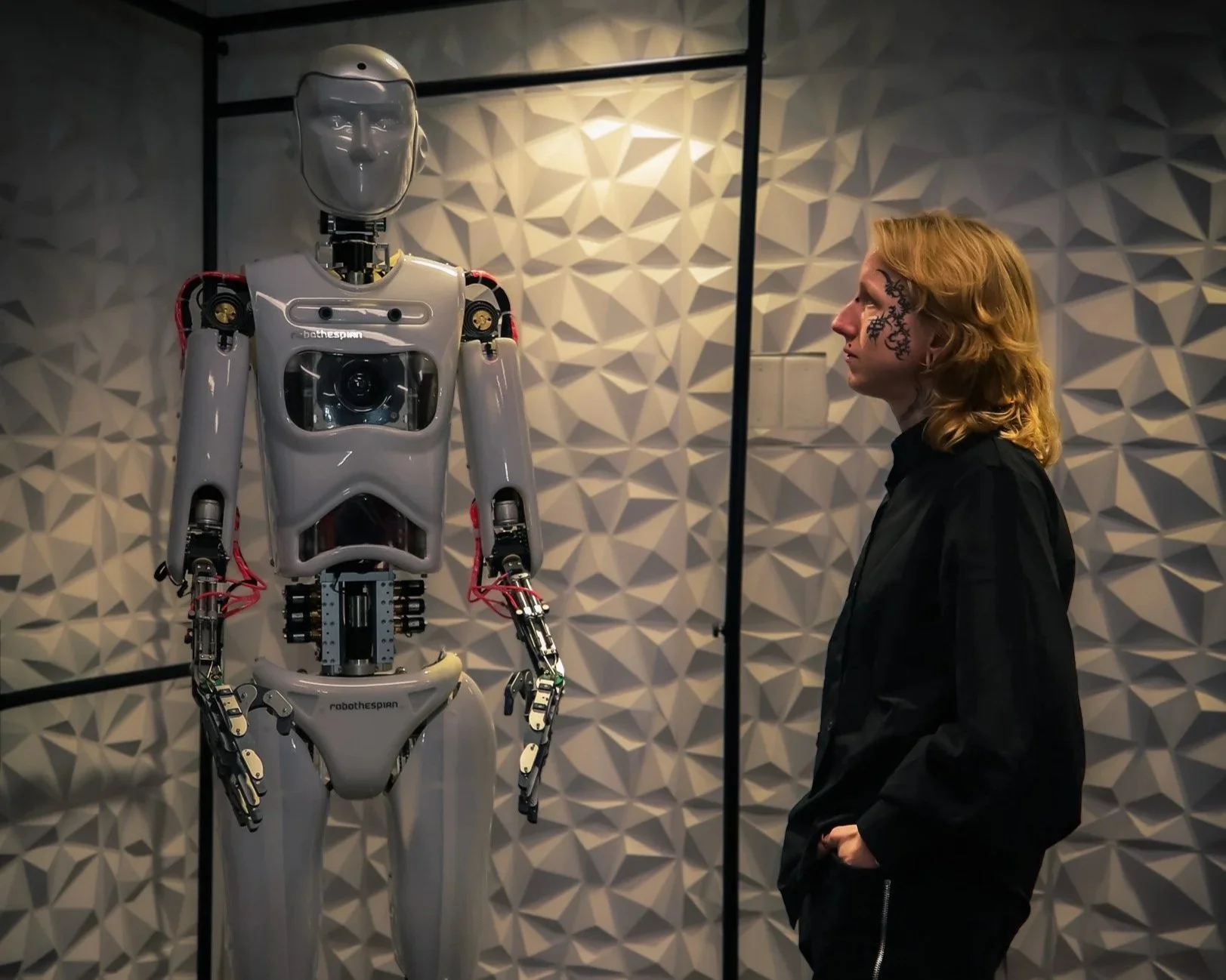
Photo by Isabella Santini
Dio Brown easily fits in with the rest of her Class of 2028 college of Engineering and Computer Science students. Aside from showing off a cyber-sigilist face and neck tattoo and zipping around campus on her recently-purchased $128 electric scooter, nobody bats an eye during her dreaded logical math class.
But Brown isn’t just another 20-year-old Syracuse University junior from Tenafly, New Jersey. She’s a barely-5-foot 37-year-old undergraduate student, a former drug addict and recession-era revolutionary that used to roam Erie Boulevard busking with her violin. She’ll tell it to you herself.
“I was one of the people most people here would turn their back to on the street,” Brown said. “I would like to shuffle across the road, and people would be honking at me, people would throw change at me. They think it’s funny. It's just so demeaning and it's so self-conscious.”
Today, Brown forthcomingly recounts traumatic stories of friendship and loss throughout her struggle with addiction with gnarly hand gestures and dark jokes in a stuffy Newhouse conference room. She goes to Bird Library every day and checks out books about the philosophy of engineering, just for fun. And, unlike many of her undergraduate counterparts, Brown is in phase-two of developing an artificial intelligence model she hopes will become the first to be fully conscious.
So, how does a former panhandler get to trailblazing an extremely controversial and nuance-necessary AI model? To Brown, the throughline has always been about helping people—even when she hasn't felt helped herself.
Adopted into a family in Manlius, a suburb of Syracuse, Brown grew up homeschooled and a classically-trained musician. In photos she’s recently recovered from coming back in contact with her adoptive mother, she rocks bright blonde fringe bangs, pleated skirts and chiffon blouses, a stark contrast to the black beanies and assortment of tech company sweatshirts she sports today.
While there’s “no right way to put it,” Brown said she’s always felt like an outsider. She started having episodic impulses—like when she first started her liberal arts education at SUNY Geneseo in 2007, she first experimented with pills and a bottle of Bacardi 151.
“I’ve always been a person that wanted to be at the edge of things. I thought it was somehow glorious to not care. It’s not. It’s just sad,” Brown said. “I had no sense of safety, no sense of danger. That’s crazy to me now, because I care so much.”
When she dropped out of college and returned to Syracuse, she stayed with boyfriends and ex-bandmates in sketchy houses and precarious situations. Later, she met her current partner, Chris, who’s stayed with her through her journey for “better or worse.”
But between experimenting with new drugs and bouncing between precarious living situations were some perks, she says. In 2011, she became one of the leading organizers of Syracuse’s Occupy movement out of the economic recession. She developed rules of engagement for homeless encampments on Polk Street and made extra money by busking with her childhood violin. It was through her activism that she caught the attention of organizers at the Workers Center of CNY—where she eventually landed herself a job helping undocumented workers and protecting their rights.
During this time, which Brown fuzzily recalls her twenties without a real knack for dates or chronology, she lived a double life: bouncing between missions and shelters, running with drug groupies, and taking part-time jobs at places like Chipotle while also dedicating herself to helping those in need.
“I was at Five Guys drunk off my ass but still trying to get us to unionize,” Brown said.
But like for many of those struggling with addiction, Brown’s life started to take a turn for the worse. What started as getting off on long blunts of spike and molly soon turned to using heroin, which eventually led her down a long road to recovery.
“I just felt too comfortable. All my friends were around there, so I had these silly ideas: I’m a gangster, this is my identity, this is so cool, and all those things with me being radical and edgy,” Brown said. “They got mixed in with this nastier thing, something that carried violence and drugs along with it.”
Things changed for Brown in 2022, when her best friend, Dylan Ursino, died of an overdose. While Brown had already gotten sober before this point, she said this was a sign to really get her life back on track. Before his death, Brown said she and Ursino had already registered to study at Onondaga Community College together. That’s when a grief-stricken Brown decided to channel her guilt, sadness and anger into action.
“This is quite challenging: but I think that if you see someone that you say that you love die from drugs, and then you use them, I think you should question whether you actually loved them,” Brown said. “I wanted to run as far as I could in another direction.”
Brown began full-speed ahead in OCC’s first cohort of the electromechanical training program in 2023. When she started working under mechanical engineering professor Michael Grieb, she developed an affinity for robotics—and even founded OCC’s first robotics club. For Grieb, Brown’s story inspired the way he teaches his students in his fabrication labs. He recalls the time Brown was fascinated by using cordless drills, something he didn’t realize could be so revolutionary to students of different backgrounds.
“Sometimes I just assume what students have experienced, or what people know or have been through, especially with something like that I've used millions of times in my life,” Grieb said. “Because of that one little comment, we now have implemented that as a lab activity in some of our tools classes to make sure that every student knows, you know, the power of this cordless drill.”
By the time Brown graduated with an associate degree in 2025, Grieb nominated her for the Jack Kent Cooke Scholarship—an extremely selective national full-ride transfer scholarship for undergraduate students.
“They've been really on fire ever since I met them,” Grieb said. “I didn't really have to do much other than give them some guidance along the way.”
In her application, Brown described what she—in her existential mind—wanted for the future of AI. While working with Grieb, Brown first learned about a different approach to AI: “embodied” robots that learn the way a person does, by looking at and moving through the physical world rather than absorbing text and image data from the internet, the way that chatbots like Claude and ChatGPT operate. Her imagined robots—which she has preliminarily trademarked “Nomic Systems”—would teach themselves to recognize patterns and understand space, which she believes could one day make them fully conscious beings.
While, for many, the idea of a self-operating fully-conscious robot is a post-apocalyptic nightmare, Brown argues that it is not nearly as dangerous as the proliferation of cloud-based, online AI systems. She believes—and has to research to prove—the reason AI replicates anthropological human biases is because AI pulls from information that’s already out there.
If a robot was able to make its own decisions, deduce its own logic and understand the world through its own eyes, she argues developers could make AI models that are easier to control and use for good.
“If what I'm saying is true, then a [current generative] AI that would be responding to us as if it feels like it should have rights or it needs respect would not be real. That would be just probabilistic. It would come from its inputs, simply spitting out what is the most logical next step in this context,” Brown said. “I want a hypothesis machine, it makes a hypothesis about reality, and then it basically checks it by returning to the spot or by seeing things that are around it.”
Optical AI is also known for using a fraction of the energy and water that giant servers need, which Brown says could be one step closer to aiding the national data center discourse.
And Grieb’s nomination paid off: Brown was one of only about 90 nationally awarded the Jack Kent Cooke scholarship. With her tuition, housing and meals paid for: she transferred to SU last winter to make these robotic dreams become a reality. With the help of the Blackstone Launchpad and SOURCE, SU’s epicenter for funding student research and other creative endeavors, Brown has gotten the funding to make her robots become a reality.
But Brown isn't building robots for the sake of building them. She hopes that one day they might care for the people she knows best: the elderly, the lonely and those in recovery, as she once was.
“I'm going to refuse all military service at all,” Brown said, rather assuredly. “I want it to be the bot that we can trust in scenarios that are high stress or very kinetic.”
These days, nights at home are spent playing video games for Brown, hanging out with Chris and her cat, Hatchy Patchy Scratchy, or strolling through the scenic loop trail at the local Clark Reservation. While her and her partner both continue their educational paths, Brown hopes to one day go wherever her product could best serve her.
“I really love my city, and I want to help it, like, so much,” Brown said. “I'll go wherever it makes the most sense.”