
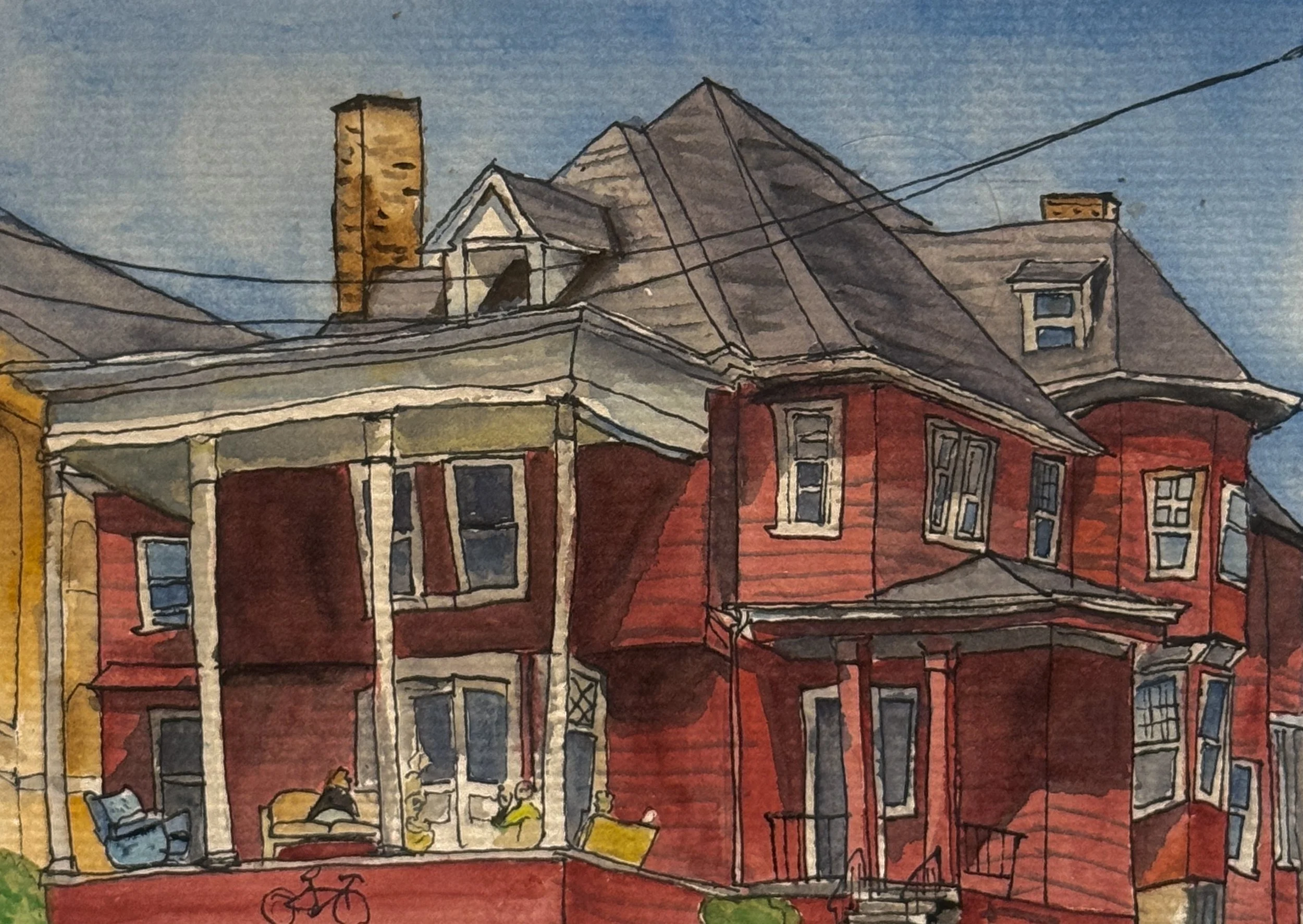
Graphic by Max Weinstein
For the last two decades, the 700 block of Comstock Ave. has been characterized as “frat row,” featuring all of the glitz and glory of Syracuse University’s Greek life. A row of fraternity and sorority houses sit behind the Life Sciences Complex, sandwiched between Ernie Davis and Shaw residence halls. The block grows crowded on Saturday nights with the bustle of frat hopping and partying. But up until 2004, students lived and partied in a different type of institution on Comstock, one unaffiliated with Greek life and SU as a whole. The building at 747 Comstock Ave, which today houses members of the Sigma Alpha Mu Fraternity, served as an artistic, counterculture space known as the RedHouse (and yes, it used to be red). And you wouldn’t be reading Jerk without it.
Originally built as a fraternity house, the RedHouse came to house students from the College of Visual and Performing Arts as well as architecture and design students around the ‘80s. By the early 2000s, students from a variety of programs could be found living in the 15-bedroom home. In addition to being a residence, the RedHouse also hosted parties, art shows and live music.
“The RedHouse was punk as fuck,” said Carl Cowan, a former RedHouse resident. “The Red House was a space where you could have conversations and engage in social critique, and participate in dialogues that weren't necessarily those that were the common expectation of that time.”
Students like Cowan would apply to live in the RedHouse for the upcoming school year and be selected by its current residents, who hosted open houses and other events as a way to gauge interest and get to know prospective housemates.
Once selected, students lived under a relatively typical housemate agreement—despite having between 12 and 15 roommates sharing the space. While the house had a leadership structure, a president, treasurer and other executive positions handling the business aspects of life there, residents adhered to a household chore rotation and attended monthly meetings regarding the shared space and handling of the funds generated from parties and events.
“We had residents who reflected a broad cross-section of the student body at the time. It wasn't just art and music students,” Cowan said.
Cowan himself studied information management and technology, and recalled other iSchool and Engineering and Computer Science students living alongside him.
While the residents hosted art shows regularly for the greater Syracuse community, the house itself existed as its own sort of gallery everyday.
“Every surface of the RedHouse was covered in art or graffiti or historical reference from preceding house members. The entire interior of the house was an art installation,” Cowan said. “You were challenged and encouraged and instructed and confronted with all manner of expression and thought at every turn on the inside.”
Residents and visitors found various works of art from graffiti and spray in the so-called “Doom Room,” to a freehand of Andy Warhol’s Marilyn Monroe adorning the walls of the house.
But the culture of expression did not end with visual art. Student bands performed and practiced in the house regularly and residents were eager to contribute to campus media. Enter Jerk Magazine.
In April 2003, a group of SU students noticed a gap in coverage by campus print media outlets. Few and far between at the time, the options primarily consisted of The Daily Orange and The Student Voice, a weekly magazine. According to Jerk co-founder Tasha King, these publications focused heavily on campus life, university issues and sports reporting—but King and her peers had more “substantive” writing in mind.
“I remember very clearly, like the conversation that we had outside of class, where I was just like, "Why isn't there? That's bizarre. Like, if there is a daily newspaper, there should be a monthly magazine. Period,” King said. Like that just seemed so obvious to us at the time, and we were like, well, let's go apply for funding and make a magazine.”
Then-sophomores King, Jeff Linehan, Katy Coleman, Corey Carson, and Jessica Feder formed Jerk’s first editorial board, with Elizabeth “Liz” Binkley serving as its first art director and designer. Several of the founding members approached the project of creating Jerk knowing what they wanted to focus on — Linehan on investigative stories and features, Carson on arts and entertainment and King to serve as the mag’s first managing editor.
“I just feel like it's my personality in a way. Like, I think that was probably obvious to everybody in the room but me. That, of course, [King] will be the person who will keep us organized and will create a publication calendar for us and make sure that we have deadlines and this is workable, that something actually comes together,” King said of her appointment.
Though King executed much of the work of an editor-in-chief, she refused the title itself, wanting to feel more connected to rather than dictatorial over the people she was creating Jerk with.
“Jerk, I think, was the closest at the time to a genuine sort of produced representation of, if not what the RedHouse was like, what people at the RedHouse were capable of in terms of expression and social thought,” Cowan said.
King explained how being associated with the RedHouse allowed her and the editorial board to present themselves as creative people who pushed boundaries.
“We definitely wanted to be perceived as edgy, that's why we put naked bodies on the front cover of the first issue—because we liked that feeling, and I think we probably still do,” she said.
The RedHouse was even featured in a Jerk photoessay in 2004, showcasing “the final hours of the RedHouse.” Following the 2003-2004 academic year, the house would transfer ownership to members of the Tau Kappa Epsilon Fraternity. In 2015, the Sigma Alpha Mu Fraternity acquired the property and has occupied it ever since.
The 2004 photoessay featured images of the interior of the RedHouse as its final residents knew it, accompanied by reflections on the art and memories held in the space.
Cowan said the outgoing residents were “a mix of heartbroken and furious” at the news that they would be losing the house. Part of what they were mourning was the house as a refuge for queer student life.
“Queer life in Syracuse in the early aughts was definitely not as open and flourishing in the way that I understand it to be now, but I can at least say that the RedHouse was always open and welcoming, and fought for everyone's right to expression and to live the identity that suited them,” Cowan said. “Anyone could come to the RedHouse and be their truest self, be their fullest self, and I like to think that our community was understood as being able to provide that, and anybody that came through our doors knew that they were among safe community when they were there.”
King remembers the RedHouse as “a special ass place,” and how the RedHouse’s community extended beyond its residents and the university. Local musicians and artists, SU students and Syracuse natives crossed paths there through the parties, live music and creative work. The house helped connect “the university and the townies and the artists all together in one place,” King said.
For Cowan, what remains is the sense of radical acceptance and love that the house fostered.
“I think the thing that I remember most, like my most vivid memory, is just how seen and loved I felt there all the time, like without question, no reservations,” Cowan said. “I knew I was surrounded by family, and my hope is that anybody who didn't get a chance to experience the RedHouse can know that they would have been loved if they came to visit, and they would have had a great fucking time if they hung out.”