
Photo by Lauren Steinberg
You’re jostling shoulders with friends as you dance at a crowded frat party. Colorful lights are flashing and the music is loud. Turn to your left, and the smell of something like chlorine and Sharpies catches your attention. Soon, there’s a crowd around a small glass bottle asking for a sniff.
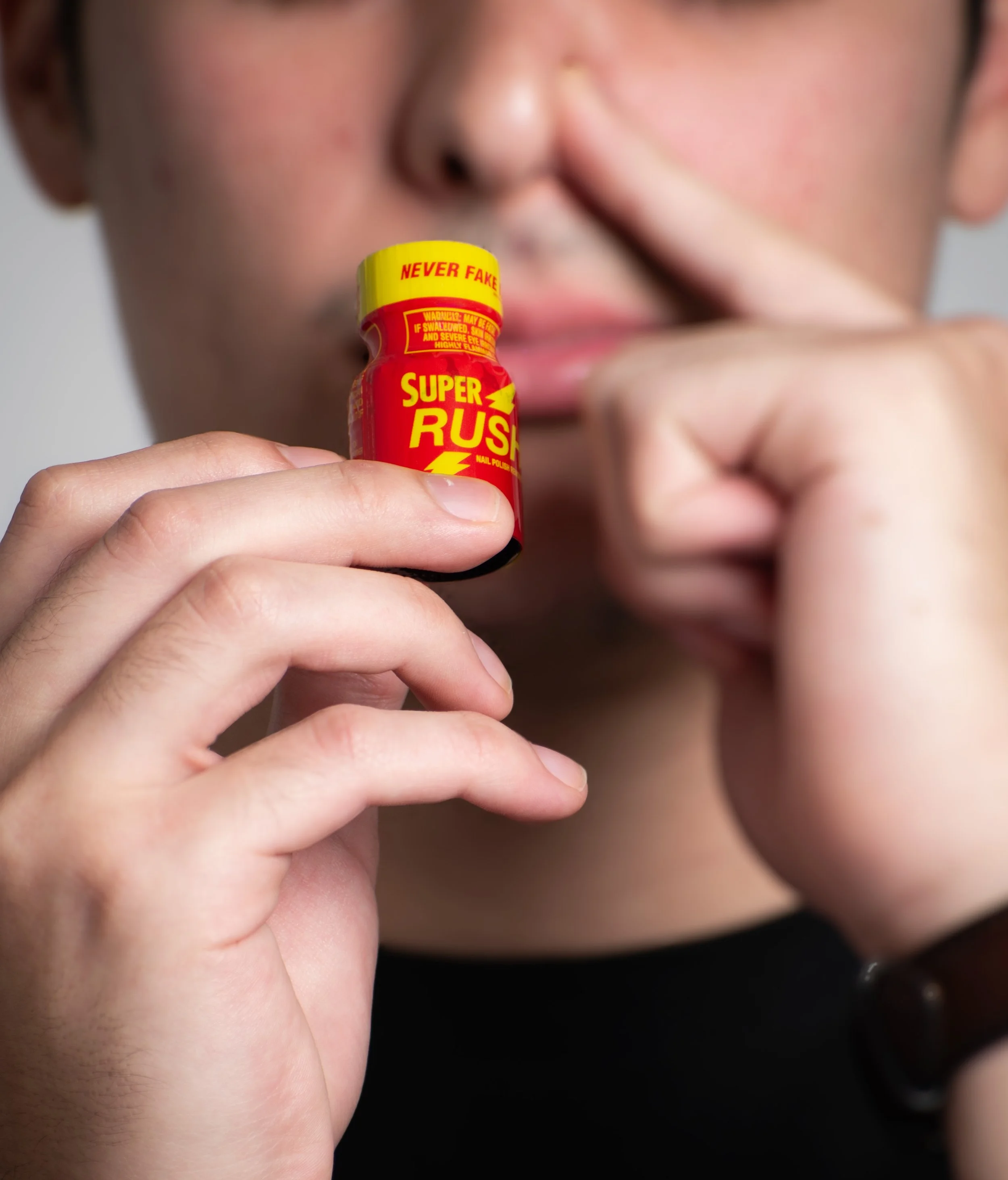
Poppers are a popular inhalant drug that’s become almost ubiquitous within Syracuse University Greek life parties. Sometimes referred to by famous brand names like “Rush” or “Jungle Juice,” poppers provide a head rush that lasts for a few seconds and relaxes the user’s muscles.
An anonymous source, who we’ll refer to as ‘S,’ said that when she’s feeling too sober at a frat, poppers can help “keep the buzz going.” They help her hear and feel the music better, she said.
But that buzz didn’t start in the world of Greek life.
Despite poppers’ recent debut into the straight college party scene, they date back to the 19th century. Originally, amyl nitrites, the chemical name for poppers, were prescribed to patients with angina, a type of chest pain that occurs when there’s not enough blood flow to the heart.
When inhaled, amyl nitrites relax a person’s muscles, and allow for easier blood flow. They also spark a momentary rush that relaxes the body, and, most notably, the butt muscles, which led to their recreational use in the gay club scene for those preparing for anal sex.
There is no clear record of when, how or who discovered poppers’ other effects. Author of Deep Sniff: A History of Poppers and Queer Futures, Adam Zmith, said it likely occurred some time between the 1920s and ‘40s.
Amyl nitrites really began to make a name for themselves in the ‘70s as a few American companies began building the poppers brand.
Poppers earned their name from their original packaging—small glass ampoules in between cloth sleeves which had to be popped to release vapors.
Sold as “room odouriser,” companies heavily directed their marketing at gay men. Ads including “hunky guys in leather” began popping up in gay magazines, bars and clubs, according to Zmith.
During the AIDS pandemic, misinformation that linked poppers to the virus spread. Although the causal link between the two was disproved, Zmith wrote that the stigma around poppers lingered.
In recent years, Robert F. Kennedy Jr., secretary of the U.S. Department of Health and Human Services, has spread false claims that poppers, not HIV, cause AIDS.
Poppers retained their popularity amongst gay circles in the ‘90s and ‘00s, but they only began entering straight culture in recent years.
“Poppers, nitrous, and beyond: Patterns of inhalant use across sexual identity groups in the U.S.,” a 2023 survey published by researchers at the RAND Corporation, examined the use of poppers across sexual identities.
While lifetime use remains the highest amongst gay males, at 39%, the study found that around 10% of heterosexual males and nearly 6% of heterosexual females reported using inhalants as well.
For adults ranging from 18-25, inhalant use in the past year followed a similar pattern, with approximately 11% of gay men reporting use– the highest of any group.
According to Zmith, use by straight people is nothing new—it’s been going on for decades. But as conversations around sex become less taboo and people begin to share their experiences on social media, poppers have gained more visibility across a broader audience.
Troye Sivan’s 2023 hit “Rush,” a nod to one of the most well-known poppers brands, is one marker of the drug’s entry into the zeitgeist.
Now, in the hands of fraternity and sorority members, poppers have moved far from their history in the queer community.
“I wouldn't say they're marketed that way at all,” S said. “Anyone who's using them, like when they're out, their first thought isn't like, ‘oh, I'm using this for sexual enhancement.’ It's like, ‘oh, I'm just using this for a buzz.”
When S’s friends first offered her poppers, she said she was worried about their original use: she felt like she wasn’t the "intended user,” S said. The sexual uses and queer history were the first thing K, an SU senior, heard about them too, she said.
S came around to the idea of using poppers because she saw so many friends using them, and concluded she might as well try. Older members of K’s sorority compared them to smelling salts or a nicotine buzz.
“It was genuinely the craziest head rush that I've ever experienced,” S said. “Like I was doing nicotine for the first time ever.”
Trying poppers was less intimidating for K because she said sniffing them doesn’t feel like truly consuming a substance, as opposed to inhaling marijuana and nicotine products or snorting cocaine.
SU junior T first tried poppers when he was in the process of pledging a fraternity. He knew he didn’t want to try harder drugs like cocaine and ketamine, but still wanted to experiment. Poppers were an opportunity to do that, he said.
To S, poppers didn’t feel like a big deal because they aren’t technically illegal to purchase, and she didn’t know of any negative side effects.
“Coke has much more negative side effects, and people have done really bad things when they're coked out,” S said. “But I haven't heard of anyone doing anything bad when they've been on poppers.”
Because poppers don’t inflict much of a “come down” after use that affects your next day, T said he feels more comfortable using them.
When K initially saw older girls using poppers, she knew they were doing drugs. But, she assumed they must not be that harmful because they were easily accessible from convenience stores.
Although there’s a large prevalence of poppers use, especially in sexual minority circles, there is much less guidance or research around poppers when compared to other commonly used party substances like nicotine and cocaine.
“The United States currently lacks consistent public health messaging or regulatory frameworks to promote safer use or informed decision-making,” wrote the authors of “Poppers, nitrous, and beyond…” “Our findings highlight the importance of distinguishing between forms of inhalant use when crafting proportionate regulatory and harm-reduction responses that safeguard health without pathologizing sexual or cultural practices.”
Currently, the only guidance around poppers provided by the FDA is an under 400-word advisory published in 2021 that discourages the purchase and use of poppers.
The “Poppers, nitrous, and beyond…” study also found that people who reported past-year inhalant use were more likely to report using other substances than those who did not use inhalants, and the specific substances associated with inhalant use differed across sexual identity groups.
According to lead author Megan Schuler, understanding these differences can help inform public health prevention and harm reduction efforts.
Similarly, there is limited research around inhalants that explores the consequences of long-term repeated use.
Although the immediate effects of poppers and the possibility for rare but serious risks are widely known, Zmith wrote that there is barely any knowledge around how long-term repeated use impacts people with different ages, bodies and health conditions.
Zmith emphasized the need for long-term studies that can help inform safe use while recognizing the place of poppers in queer culture.
“Every policy conversation about poppers should start with users, and with queer history, because you can't understand why people feel so strongly about poppers without understanding what they've meant to us,” he wrote.
To Zmith, it’s crucial that researchers are asking why people want the feeling they get from poppers? What does it give them?
When K first encountered poppers, she felt like the people who used them were part of a cool, niche subgroup of upperclassmen. That changed last fall. Now, they’re “everywhere,” she said. S said she sees people using poppers every night she goes out to fraternities.
That increased usage is reflected at SU’s corner market. K recently noticed a prominent container of poppers at the store for the first time. Buying poppers used to be more taboo—you’d have to ask for nail polish remover instead of grabbing from the prominent display at the counter, K said.
Now, almost every sophomore in K’s sorority has poppers available, she said. She can text a sorority group chat to ask for them and they’ll appear almost instantly. People are always willing to share their poppers, S said. They’re cheap, and sharing them feels more sanitary than sharing a vape.
T said he noticed an increase in poppers' use among his friends last spring, also connecting the trend to their availability at the corner store.
The easy access to poppers at the corner store is concerning, T said. When he tried poppers for the first time, he said he understood the potential health effects, like methemoglobinemia—a rare blood disorder. Someone encountering poppers for the first time when walking into a convenience store won’t have the same context, he said.
“I bet there are a ton of people who will walk into that cornerstone for the 1st time, see that, try it, and get hooked without knowing the damage it could do to your own body over time,” T said.
K, S and T all said they don’t experience any stigma for using poppers. However, K said she’s seen some men in fraternities initially reject poppers because of their association with gay culture.
T was aware of poppers’ history from the first time he tried them: a gay friend in high school initially told him about the drugs. It doesn’t bother him and his friends, T said.
“My friends and I have done a good job to kind of destroy this stigma of ‘only gay people use poppers,’” T said. “We've gotten rid of that toxic stigma, and now it's just kind of a funny conversation point.”
Zmith wrote that he worries that as poppers gain their mainstream fame, they’ll follow other cultural phenomena that emerged from the queer community and their roots will be erased.
“If poppers help straight people discover the pleasures of their bodies, including their bums, then poppers are doing queer work in straight bedrooms. That's fun,” Zmith wrote. “By all means, sniff, enjoy, but remember who made poppers famous.”