
Graphic by Meredith Rogers
In your 8 a.m. lecture, there’s most likely a student swiping on their phone. Locked into their screen, you wonder if it’s Candy Crush they’re playing, or maybe Subway Surfers or Monopoly Go. But alas, you’re wrong: it’s Hinge!
“I like to joke around with my friends that this is like my version of Block Blast,” single sophomore Francesca Elizardo-Dutson said. “At a point, there starts to become a disconnect.”
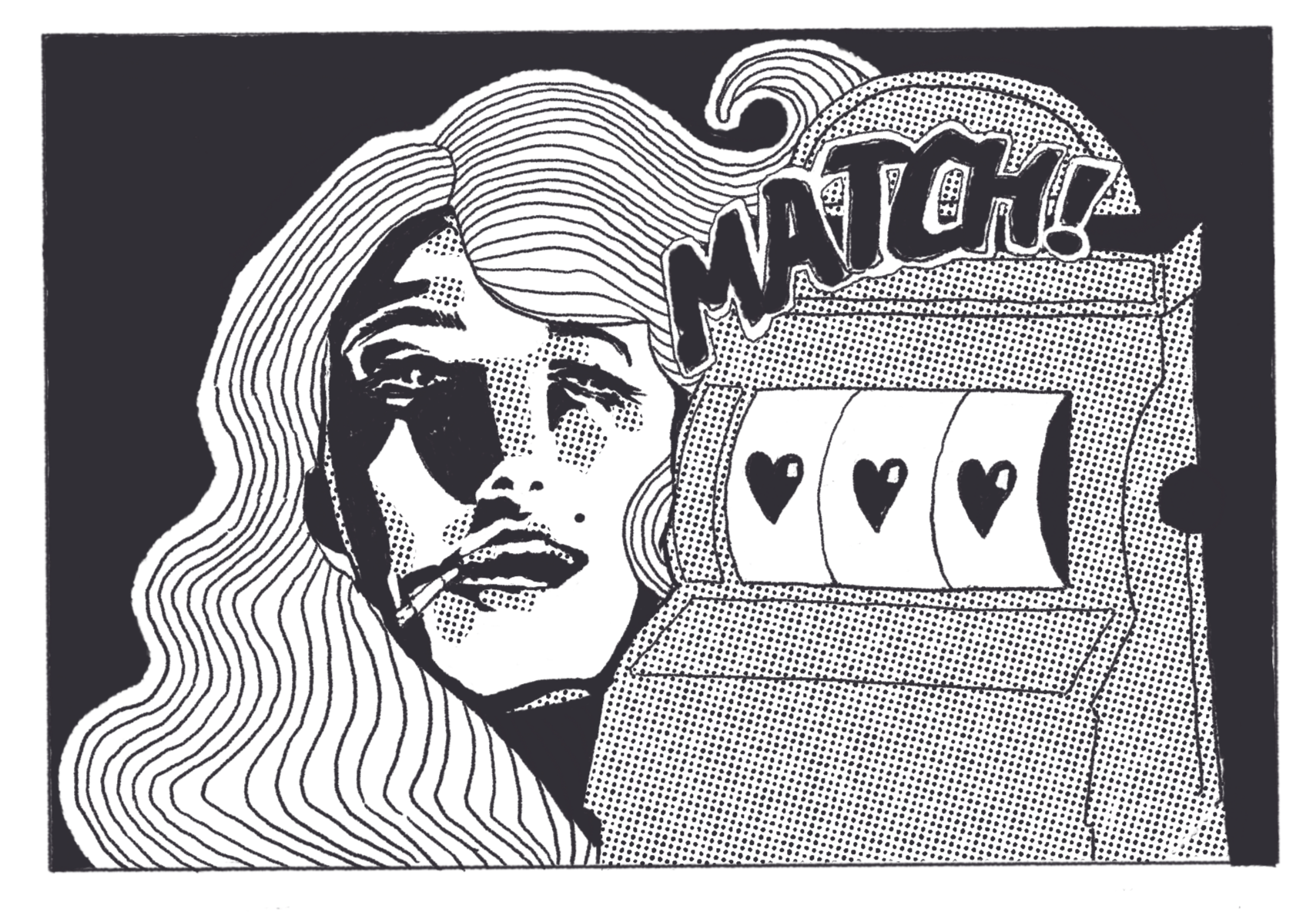
Dating apps have transformed finding a partner into a fictional game with likes, matches and rejections. For young adults using these apps, the features blur the line between real-life dating and online dating. As online dating becomes more gamified, users may behave differently on the apps than they would meeting someone organically. Apps like Tinder and Hinge use swipes, points and other game-like features to make dating feel more fictional, whether that makes it easier or harder for people to date.
Elizardo-Dutson explained that Hinge’s premise centers on habit-forming features. “It’s an addictive thing,” Elizardo-Dutson said. “Checking your likes, clicking X, writing a comment down.”
As swiping through dating profiles leans more toward entertainment, the relationships and conversations occurring on the apps become less tangible, along with the people behind the profiles.
Elizardo-Dutson explained that with apps like Hinge, you’re able to create the “idealized version” of yourself with your profile. She explained that people tend to make profiles that will appeal to someone else, not necessarily a profile that’s reflective of their true self.
There’s already a disconnect between online dating and dating in real life: it’s easy to hide under a digital facade, but it cannot protect you when you’re walking down the street. Additionally, since the profiles can be so exaggerated, it’s hard to separate the perfectly constructed profile from a real person with flaws. This also exists on other forms of social media, with users hiding flaws, mistakes and hardships, and instead only posting the good parts of life.
The distinction between online and offline dating is central to how Newhouse associate professor Charisse L’Pree understands gamified relationships. An author of two books, including 20th Century Media and the American Psyche: A Strange Love, L’Pree studies how media and technology interconnect and influence how people communicate with each other.
“Have fun on the apps, but look at it the way you look at Call of Duty. Call of Duty is not war, online dating is not intimacy,” said L’Pree regarding young people on dating apps.
If online dating often doesn’t include real intimacy and constantly ends in frustration or disgust, why do people keep using dating apps? L’Pree argued that dating apps may promise intimacy, but in reality, it is a lure to increase engagement and make a profit. She explained that this creates a tension between helping users find relationships versus keeping them engaged with the platform.
“They’re trying to keep you online as long as possible. Making a match means you will no longer pay for that service,” L’Pree said.
Although apps like Hinge advertise themselves as the app “designed to be deleted,” it’s hard to truly buy into the fact that an app that makes its money off of user engagement wants people to delete it.
Elizardo-Dutson is part of that user engagement. She understands that she might not find the love of her life on this app, but instead considers it her “fun little app.”
“It’s either that or being on TikTok or Instagram,” Elizardo-Dutson said.
Many people, including Elizardo-Dutson, use these apps purely for entertainment and less for serious relationships, and it’s not as common to find someone looking for real intimacy on Hinge or Tinder. But, no matter what we are looking for on the apps, the effects of gamified dating extend beyond the screen.
“I feel like there’s less people meeting someone organically because people are on these apps and don’t know how to act in person,” Elizardo-Dutson said.
L’Pree emphasized the value of small talk and low-stakes face-to-face interactions, even if they don’t lead to a date. People constantly complain about how hard it is to meet someone organically, but L’Pree agrees that small talk is how we can bring intimacy back into real life.
“Small talk is how we move through a society of eight billion people,” L’Pree said. “And small talk is also how we find that next partner.”
L’Pree met her husband in class, when he complimented a sticker on her laptop. 18 years later, they are still together with an 8-year-old.
“It’s the small things,” L’Pree still says today.
The smallest, most mundane conversation can lead to the most important person in your life. For L’Pree, the love of her life began with a sticker and a small conversation, not a swipe or a match.