
Sex: A Hard Pill To Swallow
Art by Sophia Chen
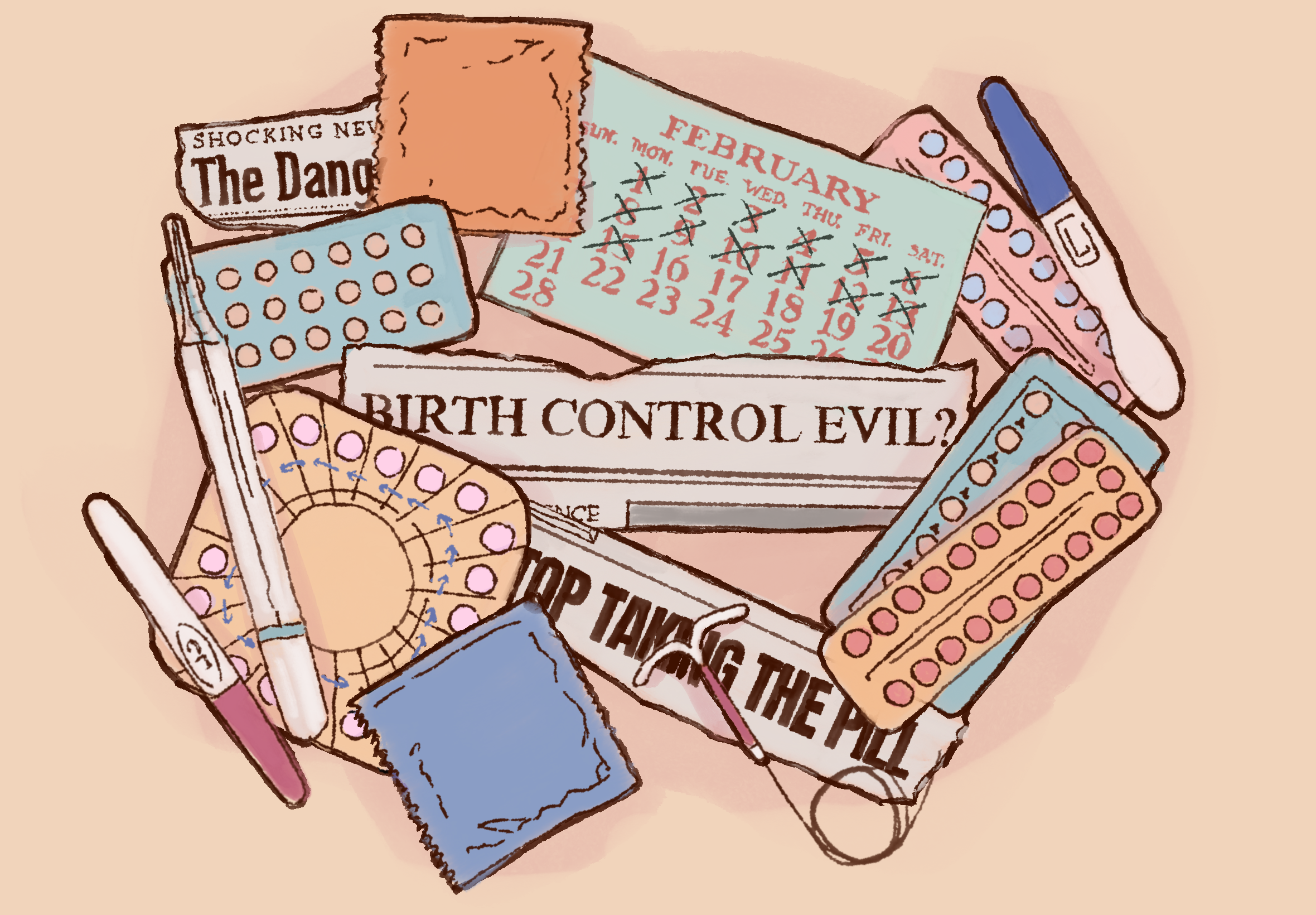
Instead of learning about birth control options from an OB-GYN about to crank you open in a sterile white room as God intended, young people are now being educated by pseudo-doctors spreading misinformation online. This digital fearmongering makes contraceptive health seem murky and confusing, so we here at Jerk want to set the record straight.
Over the past few years there has been a marked increase in contraceptive misinformation. A 2025 study in “Perspectives on Sexual and Reproductive Health” analyzed birth control content with more than five billion views and found that over half of the content disparaged hormonal birth control and over a third expressed distrust in medical professionals. Seriously, people?!
First, the basics. Hormonal birth control refers to the pill, the patch, the implant, most IUDs and the injection. It uses synthetic estrogen and progestin to prevent the body processes that make pregnancy possible. Non-hormonal birth control just means tracking your cycle and using the four phases of menstruation to predict when you are most fertile. Cycle tracking can be used as a ballpark measure of fertility, but it is far less effective for preventing pregnancy than hormonal options.
Crouse Hospital nurse practitioner Maria Giggante-Baggett said she encounters misconceptions about hormonal birth control all the time, especially about the pill and the IUD.
“People think that hormones in general are just bad for people. And in most cases, when you ask someone, they can't give you a definite answer as to why,” she said. “There's a lot of misinformation out there, and I think a lot of that has to do with social media.”
Giggante-Baggett said hormones aren’t inherently bad for the body. Some hormones, in fact, like those in certain IUDs and birth control pills, have been linked to lower chances of cervical cancer. Us Jerks who take birth control pills find this very comforting.
Influencers online are sharing horror stories about hormonal birth control’s side effects and painting cycle tracking as the wellness-focused, healthy alternative. They claim that hormonal birth control affects every area of your life and turns you into someone you’re not—Jekyll and Hyde style.
TikTok influencer @amanda_pac blamed the pill for her unpleasant feelings and claimed that now that uses cycle tracking, she “can’t remember the last time she felt really sad.” Yes, hormonal birth control can have side effects (like sadness, apparently), but it’s still a great option for many people, whether to avoid pregnancy or treat conditions like polycystic ovary syndrome and endometriosis, Giggante-Baggett said.
Misconceptions about types of birth control range from moderate to insane. Giggante-Baggett said she hears frequent outlandish claims about IUDs specifically.
“People think that when you have an IUD, every month you are giving yourself an abortion,” Giggante-Baggett said. “That’s just simply not true.”
Clubs like Planned Parenthood Generation Action (PPGen) at Syracuse University are attempting to close the information gap and help students understand these confusing concepts. Nicole Donahue, president of SU’s chapter of PPGen, organizes outreach on and off campus via legal advocacy work, phone banking and local volunteering.
Donahue said birth control options can be very confusing because women’s health is under-researched and stigmatized. Many people don’t like talking about the subject, she said.
Giggante-Baggett echoed Donahue’s sentiments. She believes women’s health is stigmatized across the lifespan, not just during reproductive years. This has resulted in a lack of research on women’s health as a whole (news that surprises absolutely no one.)
“There are some things that are definitely misrepresented when it comes to women's health care,” Giggante-Baggett said. “There's not enough conversations around it.”
Historically, Donahue said, the introduction of contraception and family planning improved women's rights substantially, because women with control over their bodies are able to pursue careers on their own timelines and choose when to have children. Female autonomy on a health level goes hand in hand with autonomy in the world at large.
We’re no conspiracy theorists, but the combination of birth control confusion with Trump administration ideology does not bode well for contraceptive access in the United States. It’s more important than ever to know your facts and be prepared—both to protect yourself from misinformation and to argue with the lame condom-hating guy you meet at the bar.
“I think having control and having autonomy is the most important thing for just a person. It doesn't even need to be a woman. It can be a man, it can be someone who's trans, it can be a non-binary person, anyone,” Donahue said. “We're taking steps backwards in women's health, and I think it’s really scary.”