
POCKETFUL OF SUNSHINE
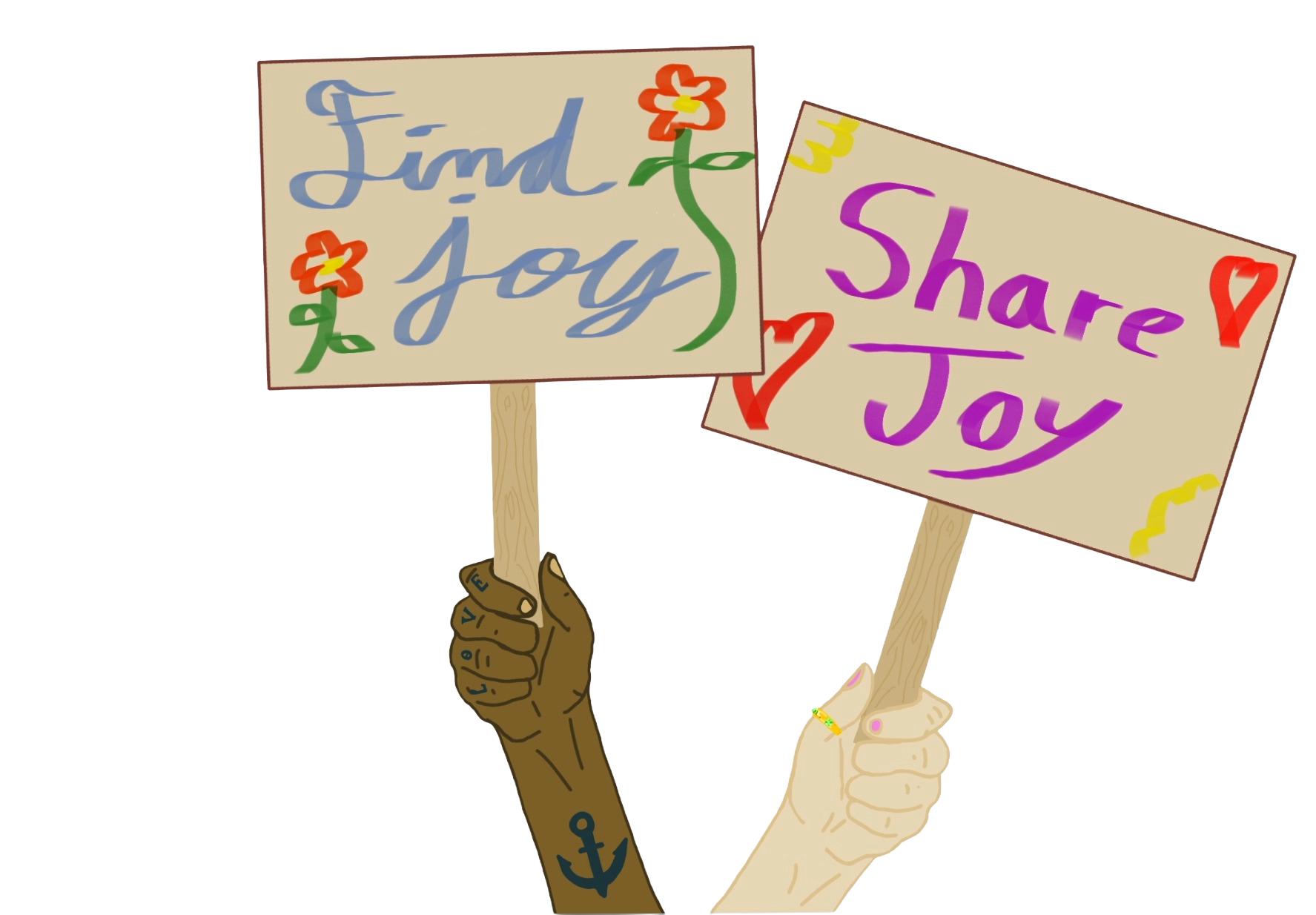
Illustration by Max Weinstein
Picture yourself at your happiest. You might be hanging out with friends, laughing so hard your stomach hurts or quietly enjoying a novel in bed. To others, it might not look revolutionary—but to you, it feels like relief. You can finally exhale.
Historically, systems of oppression have worked to convince people they are not worthy of feeling joy. This is not an accident. Hopelessness weakens people’s motivation to fight for better, making them easier to control. But history has told a different story. In movements across the world, people have found joy and used it to survive terrible moments in their lives.
Feminist poet Audre Lorde describes this idea in her 1978 essay, The Uses of the Erotic, when she argues that joy can be a form of resistance because it is “energy for change,” counteracting oppression in a non-violent way.
The Singing Revolution is a prime example. From 1987 to 1991, non-violent protests against Soviet control broke out across the Baltic states. But these were not your normal demonstrations, they were gatherings of hundreds of thousands of people to sing banned patriotic songs, eventually leading to the nations regaining independence, said Nancy Joseph, the Director of Editorial Communications at the University of Washington in a 2013 article.
Similarly, more historical evidence reveals how enslaved women in the American South would find joy, despite the brutality they endured daily, by going into the woods to host dance parties. Amidst anger and fear, these acts of joy functioned as a means of survival and resistance in the face of oppression.
Dr. Srividya “Srivi” Ramasubramanian, a professor at Syracuse University’s S. I. Newhouse School of Public Communications, said this practice can be observed even in the country’s lowest moments.
“People came up with songs of solidarity and used quilting as a means to build community, find meaning and express themselves,” Ramasubramanian said.
She details the United States’ long history of “finding joyful moments to create movement,” whether that be through art, singing or dancing.
We also can’t discuss joy as activism without mentioning queer joy. For decades, the LGBTQIA+ community has rooted its movement in celebration and unapologetic happiness. Take pride parades—“pride” is literally in the name, signifying a joyful expression of activism in spaces where people are expected to express anger over limited progress in gender and sexual equality and diversity.
But should joy be a form of protest?
Joyful moments can feel increasingly rare in today’s political climate. With the endless cycle of bad news, trying to find joy in times like these might leave you feeling guilt or shame. But joy is not the same thing as toxic positivity or ignoring injustices happening in our world–it is a mechanism of survival in trying times.
Finding joy doesn’t have to be a performance or grand gesture. It’s not having a constant smile on your face. True joy is found within, almost as if it is human nature.
“Joy is our very nature, but we live in an extremely stressful world filled with violence, aggression and hate,” Ramasubramanian said. “It is an everyday practice and an everyday form of resistance to come back to our true nature.”
We can feel happiness while also feeling pain, grief and anger towards the troubled world around us.
Erica Watts, a junior studying Television, Radio and Film, said overcoming burnout is really hard, as it sometimes leaves her feeling like there is nothing she can do to make a difference.
With the constant flow of information online, Watts often finds herself doomscrolling on social media. Rather than letting the negativity bring her mood down, she has channeled her energy into finding support in her community, whether it be putting her phone down to take a walk or making music with friends.
“We can’t fix everything,” Watts said. “But what we can do is take actionable steps to do what is in our power, like voting or attending a protest.”
So today, we at Jerk encourage you to find your outlet. Join a club. Pick up a new hobby. Whether that be watching sports documentaries, learning a new language or even hula-hooping, almost anything can act as a form of resistance. In times of extreme burnout, allow yourself a chance to regain the resilience and energy you need to continue fighting for what is right.
And remember, joy is contagious. When we finally allow ourselves to embrace it, we inspire others to do the same.