
CARING IS COOL
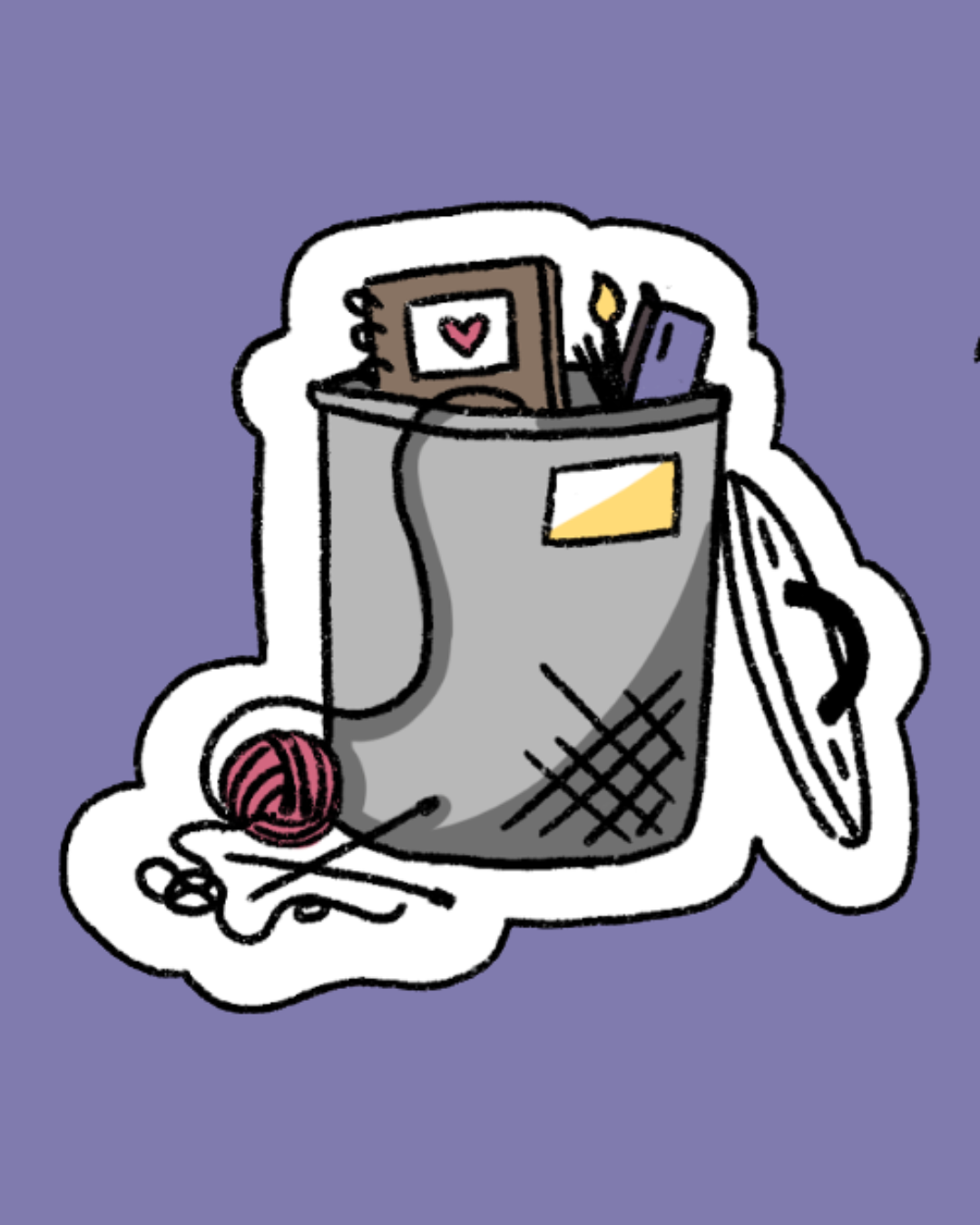
Art by Marina Lee
It's Tuesday night in a dorm room somewhere on campus. A student sits cross-legged on their bed, crochet hook moving through yarn while a half- finished assignment glows on their laptop screen. Their phone buzzes with TikTok notifications. They ignore it.
Across campus, another student scrolls through Instagram reels for the third hour straight. The contrast is stark—and increasingly rare.
We're in class, but not really there. Assignments get fed into Claude or ChatGPT. Readings are completely ignored, and theses and capstone projects—the culmination of four years and thousands of dollars—get treated like inconveniences.
The time we save by cheating on our assignments isn’t even put to good use, it’s spent on our phones. This isn't just about academic dishonesty or phone addiction, it's about something scarier: the death of intellectual engagement itself. We've created a culture where trying is embarrassing. Reading in public gets labeled "performative" and having a hobby that isn't doomscrolling is growing obsolete.
The performative label serves a purpose—it lets us rationalize our own disengagement by suggesting that anyone who does engage is just showing off. The thing is, that’s not true. Caring is cool.
Charlie Hynes, a Syracuse University sophomore, is an active member of the indoor climbing club and goes climbing multiple times a week. Some days he has to convince himself it's worth the walk to the gym, but once he’s there, he never feels regret.
Hynes describes climbing as both an individual and community sport. While he’s on the wall, the team is showing one another different ways to attempt the climb. He sees what works and what doesn't, while building friendship and camaraderie.
"It's less of a ‘I'm by myself doing this,’ and more of a ‘I'm doing this myself, but I'm being encouraged by others to do it,’" Hynes said.
This kind of community built around active engagement rather than consumption stands in contrast to the isolating act of doomscrolling.
This isn't unique to climbing. Across campus, students are rediscovering the satisfaction of making things with their hands.
Maya Collins, an SU sophomore, estimates that she spends about two hours a week on crafts during the school year—sewing, drawing and most of all crocheting. During the summer, when work and school pressures ease, that number jumps to around 10 hours.
Even during the busy school year, Collins has developed strategies to protect her craft time. She multitasks when possible, crocheting while reviewing flashcards or watching lecture videos.
Sometimes she gets caught doomscrolling through craft videos, trying to decide what to make next. But she's found a workaround— replacing short-form content with TV shows that don't fry her attention span. She watches and crochets simultaneously.
'I do feel happier at the end of the day if I crochet something, rather than just spending a day doomscrolling,' Collins said. “It doesn’t feel like I wasted my time.”
Being part of the crochet club gives her permission to step away from academic pressure. It provides an excuse to just have two good hours to crochet and chat with people. It's an opportunity to do the craft she likes while socializing—something increasingly rare in a generation that socializes primarily through screens.
Engaging with the world around us goes further than having a physical hobby, it extends into activism and civic engagement.
Melissa Martin-Neubert, secretary for a Michigan chapter of Indivisible, a pro-democracy activist organization, has spent the past year deeply involved in both political organizing and ecological activism. She educates people about native plants, fights for human rights and shows up to protests. When asked if she considers this work, her answer is immediately yes.
Martin-Neubert's activism requires the same kind of sustained engagement that Collins brings to crochet or Hynes brings to climbing. But while their hobbies build personal fulfillment, her work builds community resilience.
She describes various forms of labor involved: emotional, physical and intellectual. Sometimes the weather is uncooperative. Sometimes you yell and chant and end up with a sore throat for days.
Perhaps most importantly, there's the intellectual work.
She recalls learning media literacy in school— how to recognize when a piece only presents one perspective, identify credible sources and evaluate information critically. These skills require sustained attention and intellectual engagement, exactly what our current culture undermines.
"If you want to be heard and taken seriously, you have to know what you're talking about," Martin- Neubert said.
At protests, Martin-Neubert noticed something unexpected. The crowd skews much older than she expected. She describes seeing elderly veterans sitting in wheelie scooters at demonstrations, older people who are mad they have to re-fight battles they thought were already won.
Where are the young people? Martin-Neubert sees the problem clearly.
"If we don't start working both groups together, the older and the younger crowd, then the people who need to be able to pass the torch down, they're not going to be there to grab it," Martin-Neubert said.
The tragedy isn't just that we're cheating ourselves out of an education, it's that we're training ourselves out of the capacity for deep thought. Every time we let AI write our papers, answer our questions or do our thinking, we reinforce the habit of intellectual passivity.
The antidote to this isn't complicated, but it does require effort. It requires showing up physically, mentally and intellectually.
For Hynes, climbing provides benefits that extend beyond physical fitness. The sport pushes your mobility and strength at the same time because it's often really technical. It requires concentration, planning and active problem-solving.
"You are planning almost five steps ahead. Every single move you do, you have to be able to not just make the one move. You have to be able to make that move and then the next to get the top," Hynes said.
The same kind of sustained attention applies to Martin-Neubert's activism. She finds that being in a room full of people who appreciate her perspective helps ease the stress that doomscrolling creates. Active engagement soothes where passive consumption inflames.
We're at an inflection point. The infrastructure of disengagement is firmly established, but it's not inevitable.
Every time we choose the wall over the scroll, the book over the feed or the class discussion over ChatGPT, we push back. As Martin-Neubert asks, if you're not standing up for people in your community, why bother having a community? Why be in a society altogether if we're not looking out for people?
We need to reclaim our attention, our curiosity and our capacity for sustained thought. We need to stop being embarrassed about trying. The work starts now. Put down your phone and pick up literally anything else.