
INCLUSIVE WHO?
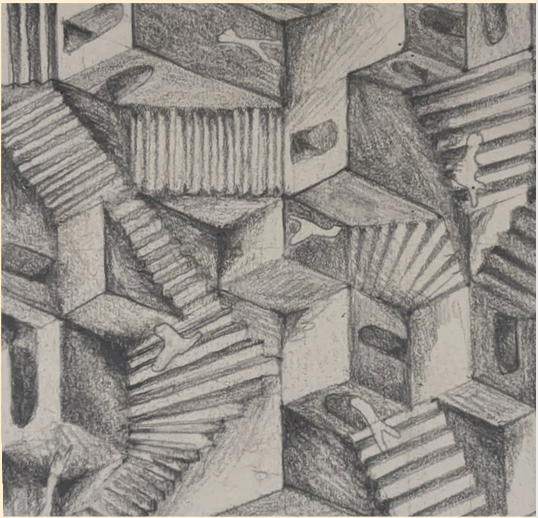
Art by Sam Arrowood
When Alison Gilmore was selected as a Syracuse University Senior Senior Marshall for the class of 2025, she found that she was unable to get on the very stage where she was expected to be honored for her achievement. The reason: there were no railings along the stairs leading to the stage.
Gilmore speaks of her experience at SU as a disabled student as a mostly positive one, though not without its challenges.
“I had an advisor and friends and other people that I worked with that were incredibly supportive,” Gilmore said. “With the buildings themselves, I personally had some issues in terms of just navigating certain auditoriums and other buildings.”
Inaccessibility is not just an inconvenience— it can send a powerful message that certain demographics are not a priority or outside the norm. According to state data, there are 544 SU students with physical disabilities. If they feel like outliers, there is an issue with the university, not the population.
Professor Donald Carr, who teaches at the School of Design in the College of Visual and Performing Arts, believes that design elements can carry more meaning than what meets the eye.
“When you have historic buildings, if you're a wheelchair user, you may feel like you're being asked to go in the back door, which sends a signal,” Carr said.
Working within the confines of historical buildings can present challenges, and it may not be possible to strike a perfect balance. But there are still small improvements to be made that can drastically improve people’s quality of life and ensure that disabled students, faculty and staff feel like a part of the campus community.
A way to ensure design elements don’t make students feel ostracized is to prioritize dignity and independence. An accessible entrance placed in a completely different area does accomplish that, and even a “technically” accessible passageway that requires a little help from a good Samaritan can be demoralizing.
“I kind of made it known that it was not an ideal situation, because even if someone wanted to offer me their arm, it’s not something I'd be interested in doing,” Gilmore said. “It's a little bit humiliating from that perspective, and I know other people might not think of it as that, but I just want dignity in that situation.”
The onus should not be on students to advocate for their needs. Students’ needs should be considered in the earliest stages of development, and not simply remembered after the fact. Thankfully, collaboration with disabled individuals when making design choices is slowly becoming the norm in the field, according to Carr.
“If you continually do this as able-bodied people, thinking you know better or you know best for others, you may be right, but you're very possibly going to be wrong,” Carr said. “And that's a loop that continually repeats itself.”
Syracuse University is a place that advocates for other educational institutions to prioritize inclusivity. SU is home to InclusiveU, a program through which students with intellectual and developmental disabilities can have a full college experience. In 1994, SU also became the first university in the United States to establish a disability studies program. These commitments to inclusivity are impressive and significant, but ensuring a physically accessible campus for everyone is equally important. Though strides have been made, there’s more to be done.
Collaboration with disabled individuals goes hand-in-hand with integrating disabled students and their support groups with the rest of the campus. Most students are aware of InclusiveU, but not many know of the other organizations and forums focused on supporting disabled students. For students to develop an understanding of accessibility in their campus environment, they must first become more conscious of the students who share the same campus. That emphasis on awareness has to come from the top down—it takes the university recognizing and sharing the contributions of disabled students and their organizations for others to take notice.
“I see a need for improvement in terms of amplifying work that the Disability Cultural Center does, from the perspective of university leadership,” Gilmore said.
The Disability Cultural Center organizes social and educational activities having to do with disability issues, involving students with and without disabilities. It is also housed within a student affairs organization, not within the disability office, which is very unique for a university program of its kind. Even with this extra step to be more inclusive, much of the SU community remains unaware of this organization and others like it.
SU is also proud of its online interactive map of the campus, which allows users to filter for Americans with Disabilities Act compliant accessibility and, within that, to filter for either accessible entrances and/ or accessible bathrooms. Once selected, the map lights up with the universal blue signs, portraying Syracuse campus as a sea of accessibility.
We here at Jerk do not dispute that this is the reality, we simply question if students who stand to benefit from these adaptations are made aware of them.
“If these accessible options exist, there needs to be appropriate signage so that people are aware that they exist,” Gilmore said.
Much of SU’s marketing promotes campus as ahead of the curve when it comes to inclusivity. In some ways this is true, but it also means they have an obligation to fulfill that promise.
This influence is more than the design of the built environment, it is amplified by the law school’s involvement with accessibility. The presence of the law school, with professors and students seeking to concentrate in disability law, means many on campus care about accessibility advocacy. This, combined with the existence of legal and sociology ventures like the Burton Blatt Institute—a research center with the aim of advancing social and economic participation by disabled people—means inclusivity is not just practiced but also preached. Professor Carr believes Syracuse has lived up to its responsibilities.
SU is literally a school on a hill, which makes its attempts at accessibility ever more critical.
“I want to say we're leaders because beyond where we started the conversation with issues of access around a hilly campus, there’s the impact we’re trying to have on the greater world,” Carr said.
Many of the issues regarding accessibility tie back to involvement of disabled students and faculty. By implementing changes and not properly alerting people to those changes, real action is wasted, made simply for appearance.
It must also be noted that there is no singular way to experience being a disabled student at SU. Every person is different and has different needs and all students’ wishes—whether it’s needing an alternative entrance or more inclusive cultural spaces—must be heard and honored by the university.
Change is slow; SU should aim to not only be ahead of the curve, but to be the school to set it.