
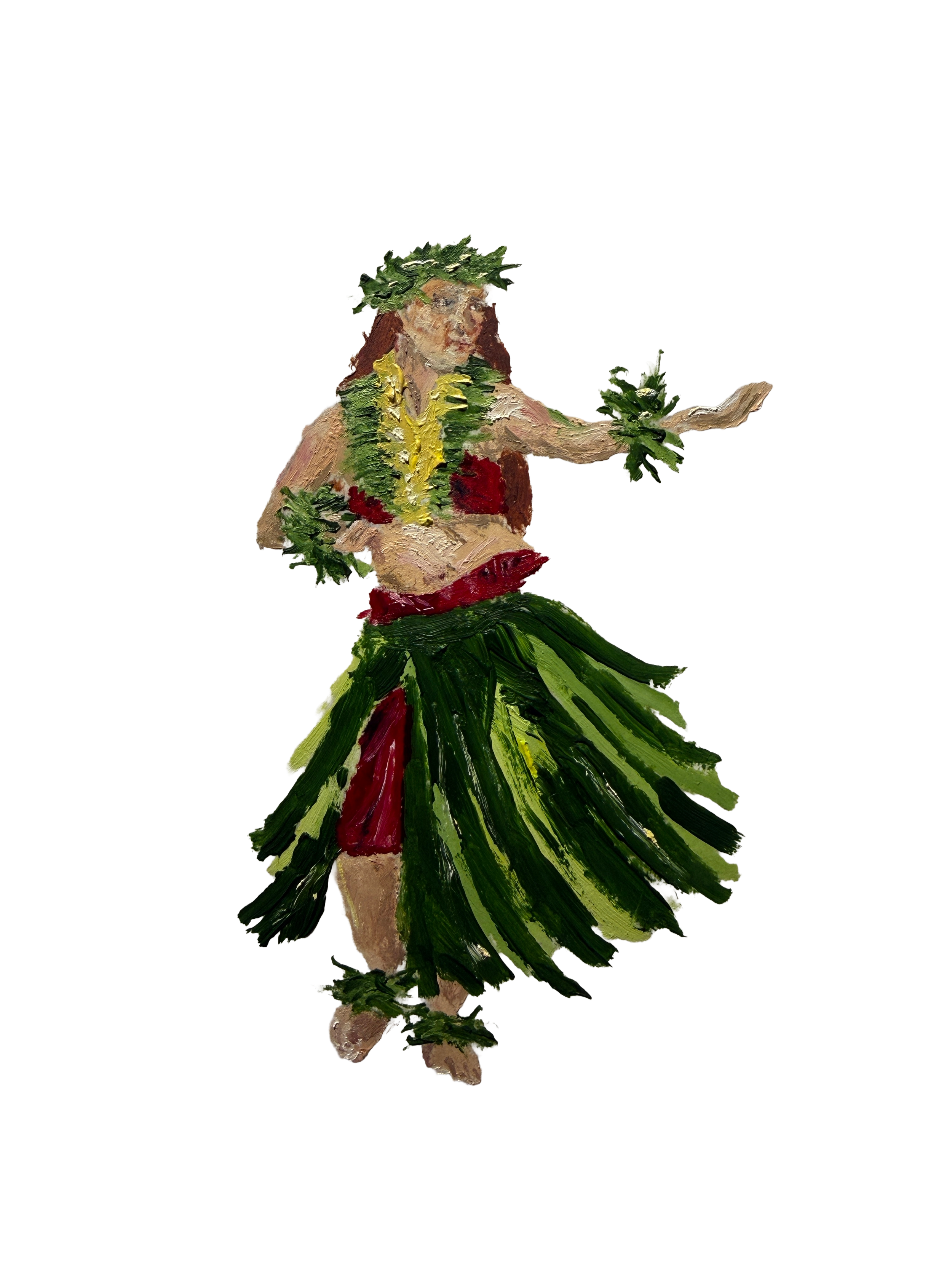
Art by Max Weinstein
As a child on Long Island with a Filipino immigrant mom and an Italian-American dad, I always wanted to meet my family who lived in the Philippines. Facts about life in the Philippines seemed so intangible because of our minimal communication and my lack of proficiency at Tagalog, the language dialect my mom’s family speaks.
However, even without close proximity to my Filipino family, I was never far away from friends who felt like family. My mom’s best friend, Leah, was my favorite tita. Her daughter, Cassidy, became my best friend. Cassidy’s older sister, Ate Monica, became my ate too. Together as young children, we joined Dance Aloha, a Hawaiian-Polynesian dance troupe made up mostly of Filipinos, through which we were taught to hula by a family friend named Tita Olivia.
I remember my first “big girl” hula lesson when I was eight or nine years old like it was yesterday. On one school night, Tita Olivia came to my family’s house to teach me the dance to “He Mele No Lilo,” a song from Lilo & Stitch. First, she taught me how to properly `ami `oniu—a step for which one rotates one’s hips in the shape of a figure eight. Learning that step alone required much instruction. That weekend, my hard work paid off when she took me to the Papa John’s in the nearby Target and invited me to perform with the troupe.
One of the most captivating elements of hula is its capacity to tell a rich and vibrant story through song, chant and dance. Not only does the language of hula communicate Hawaiian culture and history, but the dancer’s swaying movements themselves evoke the ocean’s waves. When I danced with the other keiki (child) dancers, we ‘ami’d in sync, as if we were one tide rising and falling together. Even though most of us were not ourselves Hawaiian, we treated the hula tradition as sacred.
For me, hula was a form of connection with other Filipinos—people who took pride in their brown skin and brought ube cake to every party long before it became trendy.
Even though I don’t hula with Dance Aloha anymore, I still constantly think of the profound impact being a part of its community had on my younger self. During my sophomore year of college as a studio arts major, I created a very fragile hanging fiber sculpture in the form of a hula skirt for a class project.
Before I presented my artwork at critique, I demonstrated a simple hula called “Kaholo Hula” from memory for the class. It was improper and messy; my hips swayed haphazardly like choppy waves. Yet, at that moment, I felt transported to my family’s kitchen again, dancing hula surrounded by my ohana—my family, with no differentiation between biological and found.