
MAKE AMERICA VOTE AGAIN
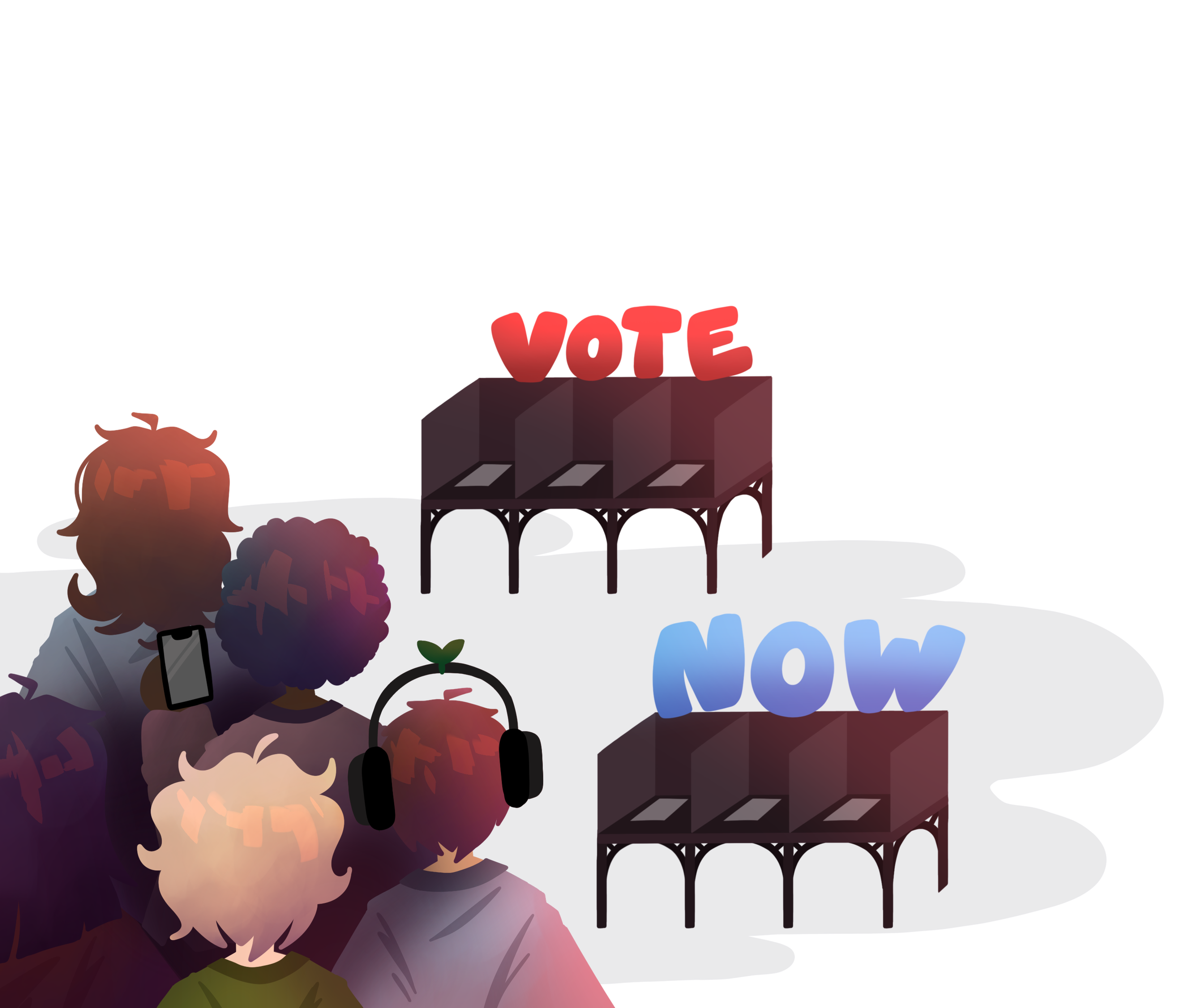
Illustration by Marina Lee
Last year, I walked four blocks from my house to the Spiritual Renewal Center on Lancaster Avenue to vote in the presidential election for the first time. According to national trends, roughly half of the Syracuse University student population did too.
Local elections, however, are a different story. In the 2021 mayoral election, Syracuse had the lowest voter turnout the city has seen in the last 100 years.
It’s not just a problem here—the United States is facing a local civic engagement problem all across the country. We aren’t contacting local representatives or attending public meetings nearly as much as we should. It’s a complex issue, but we at Jerk believe college students are uniquely positioned to make a difference.
For SU senior Kempton Bohn, low voter turnout is a big problem. Bohn is president and co-founder of VoteSU, a nonpartisan student organization that aims to increase voter turnout on and off campus. Along with vice president Thalia Benton-Dinneen, she turned the group from an initiative within the Student Government Association into a student club.
“I remember I had a very awakening moment when I was speaking to one of my best friends I've known since kindergarten,” Bohn said. “She was like, ‘I don't even think I'm going to vote because I'm just so frustrated with everything going on and I feel like my vote doesn't matter.’”
Many young people share that sentiment— they feel as though their votes are unimportant. On campus, a rising number of voices like those at VoteSU are doing their best to change that narrative and spur local civic action.
“If you can say ‘my vote started here’ then I think that that will allow people to actually feel like their voice led to something in the future,” Bohn said.
Local elections happen almost every year in Syracuse. Because students live here for more than 30 days each year, they qualify to register to vote as New York residents—and don’t have to remove registration in their home state. The government only counts votes submitted, not registrations, so as long as you are only voting in one state, you’re all set.
Young people have the power to vote for county executives, city mayors, judicial officials and more, but many students don’t realize how much those local representatives affect their lives.
SU senior Josephine Epolito worked for New York State Assembly Member Pamela Hunter, who represents the 128th district, earlier this year. She said that the community tends to underestimate the importance of their local government, which contributes to low voter turnout.
“The mayor has a lot more power than a lot of people think,” Epolito said. “The mayor has to okay a lot of the programs in the city—all those concerts they have during the summer—those are through the mayor. So many things that you see on a daily basis, the mayor has a huge impact on.”
The importance of local government isn’t just a student issue. Richard Barton, an assistant teaching professor in the Public Administration and International Affairs Department at SU, teaches three classes on public policy analysis and research.
Barton said that a friend of his who works in the Syracuse City government had a good line to sum up the issues with local politics: “The federal government is where all the money is, the state government is where all the power is, and local government is where all the problems are.”
“When citizens experience problems that are in the real world as opposed to the sensationalized social media world, these are problems that they're experiencing usually at a local level,” Barton said. “If they raise these problems to any authority, it's usually going to be a local government.”
Barton used the example of Syracuse’s recent policy decision to get new lidded recycling bins for the whole city, replacing the old open, uncovered ones. It’s made the city much cleaner as opposed to the old system, Barton said.
“If this were 40 years ago, most residents of the city—and even you transplant undergraduate students here for a few years—would still be picking up a hard copy of the local paper,” Barton said, “which would have had multiple articles about this and so you would know that this was a local government decision.”
Now, he said, people are no longer connecting those dots. With people getting their news online and outlets focusing on national headlines instead of local ones, students probably don’t notice the trash cans, much less think about the fact that they are a result of local city policy.
At the same time, social media facilitates the spread of information unlike ever before. Social media can be a resource for spreading awareness about local events and issues, especially for small grassroots groups without big marketing budgets.
“I think it does always come back to the community,” Bohn said. “If we can use social media as a means to promote community engagement, then maybe it’s the solution to the problem.”
Bohn and Barton both said local civic engagement is a systemic issue. In Bohn’s hometown in California, students are required to pre-register to vote before registering for classes in high school. But many other states have no voting education for students.
In Syracuse, even when students are educated on their voting rights, government systems make civic engagement unappealing. To combat those institutions, we have to take action wherever we can.
The Syracuse mayoral election is next month, and the voter registration deadline is in two weeks. This may not be the most exciting race to ever vote in, but it’s a great opportunity to take the first step toward being involved members of the community.
“We have an aspiring dictator as the president who's using the federal government in all sorts of ways to go after enemies,” Barton said. “We should all be developing a newfound appreciation for federalism and the fact that you have state and local governments.”
Barton said state and local governments, while dependent on the federal government in some ways, are more crucial than ever before. They can act as an independent force to check the power of an authoritarian federal government—and voters have a say in who runs them.
As a senior with plans to move to a big city when I graduate, I probably won’t be in Syracuse this time next year for the election cycle. No matter where I am, I know I will be voting and making my voice heard. I started that habit here at Syracuse, and I hope other students do too.