
CON AMOR, DE LOS MONTES DE MÉXICO
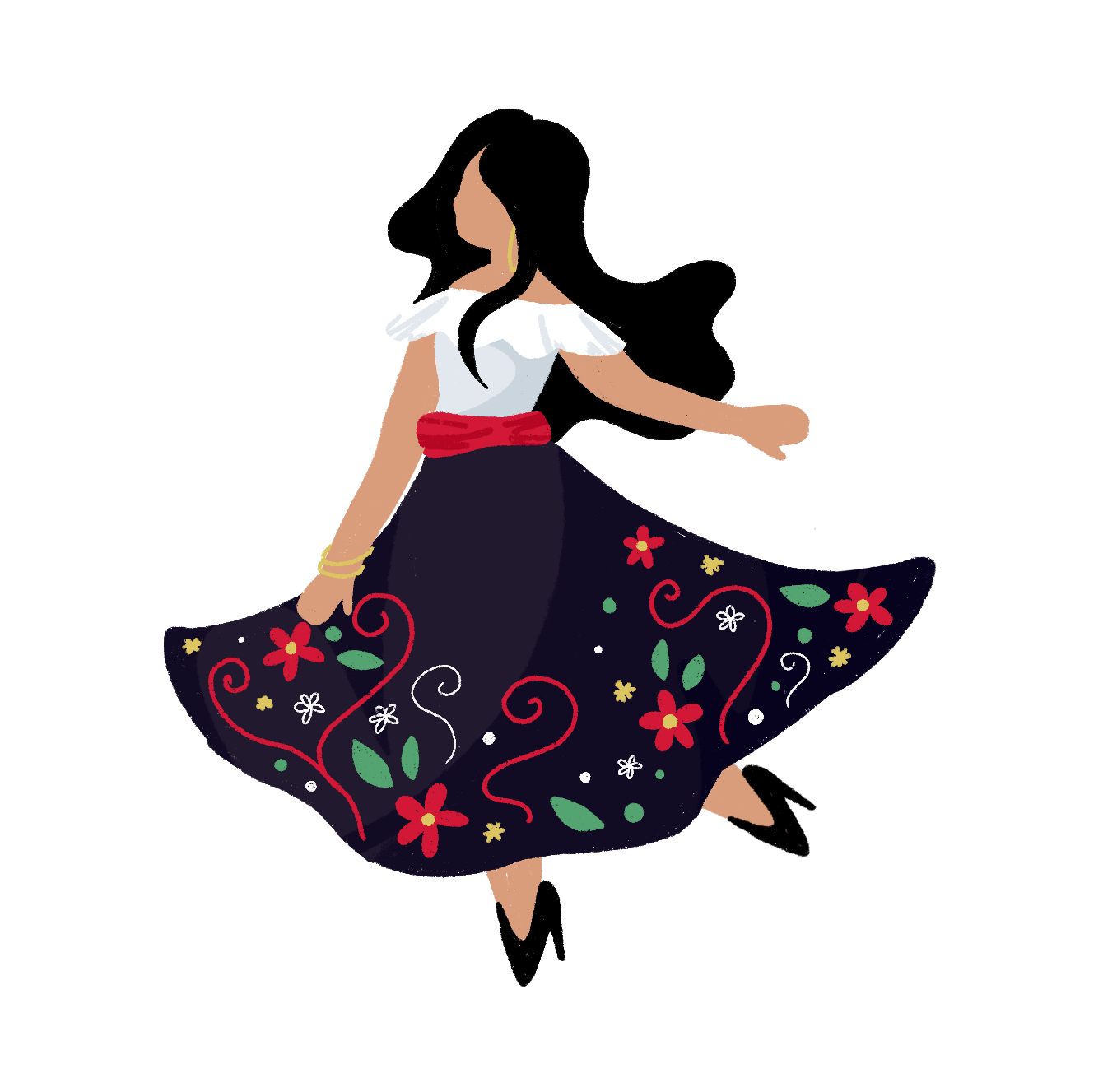
Illustration by Marina Lee
When I called my dad during his trip to Mexico in 2021, I heard horns, guitars and cheers. He was at my grandfather’s funeral, a service that did not end at burial, but metamorphosed into a parade that saw the entire town gather for a celebration of life, high up in the mountains of Mexico’s Tejupilco region in a town known as Los Pinzanes.
It’s where my mom and dad grew up, met and got married. It’s the same town all of my American family members immigrated from in the ‘80s and ‘90s, yet are always returning to, because life in Mexico’s rural mountain towns, also known as Los Montes, is different and hard not to yearn for. We here at Jerk read the literature, spoke to community members and interviewed experts to catch us up on the culture of our next few stops: the loving communities of Los Montes.
What most separates the United States’ culture from Mexico’s is the difference between individualistic and collectivist societies, a contrast that results in totally opposite approaches to community and celebration.
“Individualism implies a loosely knit social framework in which people are supposed to take care of themselves and of their immediate families only,” said Geert Hofstede, a Dutch social psychologist known for his research on cross- cultural groups. “Collectivism stands for a society in which people from birth onwards are integrated into strong, cohesive in-groups, which throughout people's lifetime continue to protect them in exchange for unquestioning loyalty."
Nowhere is this more visible than Los Pinzanes, where any event warrants inviting the whole town—a population of less than 100—over for a bash. Maribel Ureta, a daughter of the pueblo who moved to the United States in the early 2000s, described to us what these gatherings mean to her.
“Anyone who wants to come is welcome to do so. And anyone who wants to eat—well, they get fed,” said Ureta. “Everything goes smoothly when we support one another—both when people arrive and when they leave.”
What’s lost when celebration is private rather than communal is a sense of belonging. Harvard political scientist Robert Putnam observed that social capital—the traditions and trust that enable people to feel united—has been steadily declining in the United States since the 1960s. In his 2000 book Bowling Alone, Putnam notes that Americans were bowling more than ever, but alone, not in leagues. Hitting strikes against competitors isn’t the point here—it’s the lack of regular time spent with others. Choosing instead to literally stay in one's own lane.
“Our gatherings are the most beautiful thing there is,” Ureta said. “You can run, jump, and dance much more freely. But [in America], everything is cramped.”
When every day in America brings with it another stretch of separation, we should consider the communal love of Mexican mountain culture. Things don’t have to feel constricted. Invite all your neighbors over and feed them. Miss them when they leave. This is community. I’ve been trying to replicate this way of being ever since I heard those cheers through the phone—when I realized we don’t have to bowl alone. Even now, readers, no matter how far away or unfamiliar we may seem, know that in my head, there will always be a parade for you.